

Unemployable Graduate
Advertisement
  • Home
  • Education
  • Economics
  • Public Policy
  • Workforce
  • Videos
  • Privacy Policy
  • Contact Us
No Result
View All Result
Unemployable Graduate
  • Home
  • Education
  • Economics
  • Public Policy
  • Workforce
  • Videos
  • Privacy Policy
  • Contact Us
No Result
View All Result
Unemployable Graduate
No Result
View All Result
Home Economics

There’s no denying the rule of law has a positive economic impact

September 24, 2022
in Economics
0
There’s no denying the rule of law has a positive economic impact
190
SHARES
1.5k
VIEWS
Share on FacebookShare on Twitter


What drives economic growth and job creation, and decreases poverty? This is today’s dominant concern for senior policymakers in our cities, states, and, indeed, the entire country. 

Adam Smith in “The Wealth of Nations” provided an answer much earlier in a related context: “Commerce and manufactures can seldom flourish long in any state which does not enjoy a regular administration of justice, in which the people do not feel themselves secure in the possession of their property.” More generally, human progress is a function of ideas, individuals and institutions.

Related articles

Economic Surprises Could Fuel Fed Deja Vu for the 2010s – The Wall Street Journal

Economic Surprises Could Fuel Fed Deja Vu for the 2010s – The Wall Street Journal

April 11, 2024
How can we tackle the UK’s housing crisis? – Economics Observatory

How can we tackle the UK’s housing crisis? – Economics Observatory

April 10, 2024

Economic growth has three primary determinants: physical capital growth, human capital growth and technological innovation. If individuals are less confident their private property rights will be enforced, they are less likely to invest in physical capital (retail outlets, business facilities, manufacturing plants and equipment). If a city does not enforce respect for private property rights, expropriation can occur in the form of looting and the threat of armed violence against the owners of the physical capital. Businesses will respond by choosing not to operate in such cities; this will lead to the loss of jobs and diminished economic activity.

Human capital is more difficult to expropriate. The primary reason most individuals invest in human capital (education, trade apprenticeship, professional training) is it enhances their ability to generate income and create wealth. As property crime and violent crime in a city deteriorate, people living in such cities are motivated to leave and move to safer areas. People with higher education and professional training, aka knowledge workers, are more likely to have the economic resources and job opportunities to move to a safer city. In a mirror image of this phenomenon, companies that employ knowledge workers as human capital would be motivated to move from cities with deteriorating crime to safer cities. As these knowledge workers and companies depart cities with growing crime rates, this has a negative multiplier effect on job creation and economic growth. 

Technological innovation, primarily driven by the intellectual and creative efforts of knowledge workers, is a key driver of economic growth. Hence, knowledge workers and companies departing cities due to crime compound the negative multiplier effect. 

My colleagues and I constructed two proxies for the rule of law in 199 of the largest U.S. cities: the rate of violent crime per 100,000 people, and the rate of property crime per 100,000 people. Per data from the FBI’s Uniform Crime Reporting (UCR) program, violent crime is composed of four offenses: murder and nonnegligent manslaughter, rape, robbery, and aggravated assault. Under the program, property crimes include the offenses of burglary, larceny/theft, motor vehicle theft, and arson. We obtained corresponding data on job growth rates and poverty rates from the U.S. Census Bureau’s Decennial Census and the American Community Surveys.

Figure 1 highlights that cities with higher current property crime rates experience lower job growth rates in the future. Besides the size of the economic pie, which is related to the job growth rate, senior policymakers and media across the country are increasingly concerned about how this pie is sliced in terms of poverty and income inequality. 

Graphical user interface, application, Word

Description automatically generated

Figure 2 highlights that cities that have a higher current property crime rates experience higher poverty rates in the future. Conceptually, as law and order improves in a city, its citizens and businesses have greater confidence that they can enjoy the benefits of their investment in physical and human capital; that increased incentive to invest in physical and human capital leads to more jobs and income for the broader citizenry, resulting in less poverty.
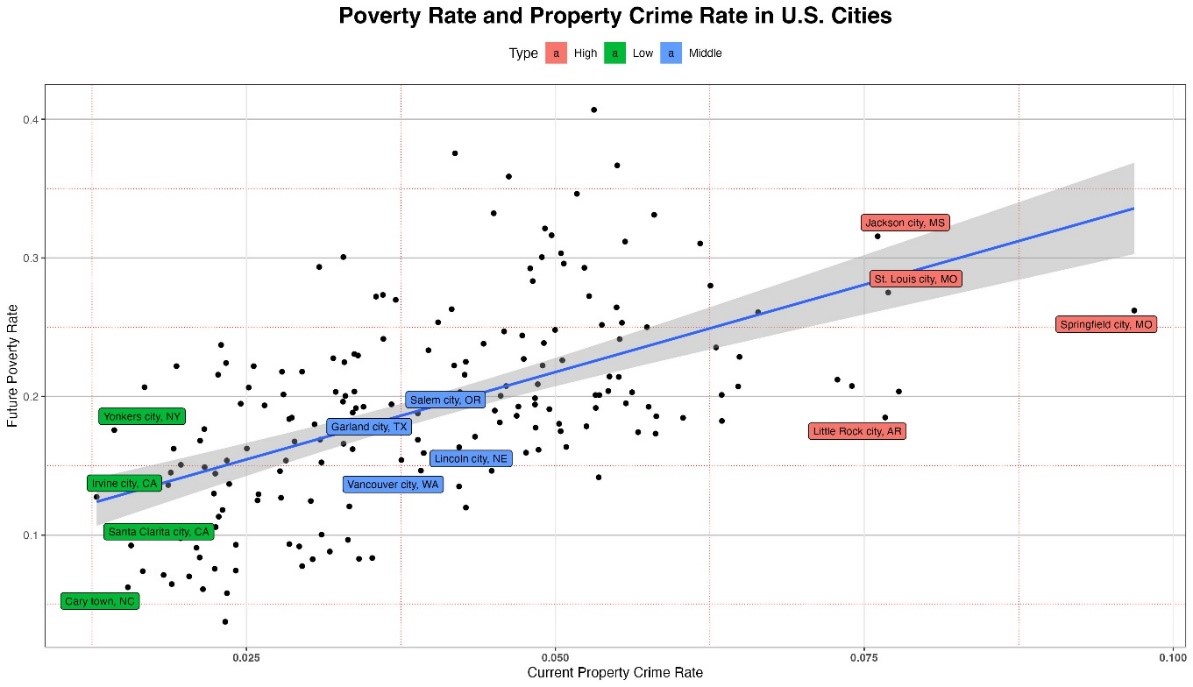
Chart, scatter chart

Description automatically generated

In a more formal analysis, we found that the above results are statistically significant. Also, we found that cities that had higher current violent crime rates experienced lower job growth rates in the future, and cities that had higher current violent crime rates experienced higher poverty rates in the future. Once again, these relationships are statistically significant.

We need resilient health systems to address the dual crisis of infectious and chronic diseases

Putin’s draft validates the virtues of America’s all-volunteer force — now is the time to save it

None of the above results are particularly surprising. In an earlier study, we did a comprehensive analysis of the empirical relationship between economic growth and the rule of law using panel regressions for 134 countries from the period 1984-2019. We documented a significant positive relationship between rule of law and GDP per capita. Also, we documented that countries with greater adherence to rule of law are characterized by less income inequality. 

The above analysis leads to the following policy recommendation for political leaders in various cities and states around the country: Focus on ensuring respect for private property rights, effective police forces, prosecutors willing to enforce the rule of law, and fair courts. This will enhance the economic prosperity of your citizens and diminish poverty in your region.

Sanjai Bhagat is Provost Professor of Finance at the University of Colorado, and author of “Financial Crisis, Corporate Governance, and Bank Capital,” published by Cambridge University Press. 



Source link

Share76Tweet48

Related Posts

Economic Surprises Could Fuel Fed Deja Vu for the 2010s – The Wall Street Journal

Economic Surprises Could Fuel Fed Deja Vu for the 2010s – The Wall Street Journal

April 11, 2024
0

Economic Surprises Could Fuel Fed Deja Vu for the 2010s  The Wall Street Journal Source link

How can we tackle the UK’s housing crisis? – Economics Observatory

How can we tackle the UK’s housing crisis? – Economics Observatory

April 10, 2024
0

How can we tackle the UK’s housing crisis?  Economics Observatory Source link

Trump v Biden: who's ahead in the latest polls? – The Economist

Trump v Biden: who's ahead in the latest polls? – The Economist

April 10, 2024
0

Trump v Biden: who's ahead in the latest polls?  The Economist Source link

Experts touch on the economic impact of the NFL draft in Detroit – WILX

Experts touch on the economic impact of the NFL draft in Detroit – WILX

April 9, 2024
0

Experts touch on the economic impact of the NFL draft in Detroit  WILX Source link

China, U.S. to deepen economic coordination – ecns

China, U.S. to deepen economic coordination – ecns

April 9, 2024
0

China, U.S. to deepen economic coordination  ecns Source link

Load More
  • Trending
  • Comments
  • Latest
Hilarious video explains principles of economics

Hilarious video explains principles of economics

August 21, 2022
HVAC Maintenance Checklist Templates: Download & Print for Free!

HVAC Maintenance Checklist Templates: Download & Print for Free!

May 18, 2023
Public Knowledge Responds to MPA Chairman and CEO Charles Rivkin on Site-blocking

Public Knowledge Responds to MPA Chairman and CEO Charles Rivkin on Site-blocking

April 10, 2024
Policy & Politics Journal Blog

Policy & Politics Journal Blog

August 14, 2022
Policy & Politics Journal Blog

Policy & Politics Journal Blog

0
Spotlighting interpretive approaches to public policy scholarship – Dr Tiffany Manuel on intersectionality – Policy & Politics Journal Blog

Spotlighting interpretive approaches to public policy scholarship – Dr Tiffany Manuel on intersectionality – Policy & Politics Journal Blog

0
Policy & Politics Highlights collection on policy and regulation August 2022 – October 2022 –free to access – Policy & Politics Journal Blog

Policy & Politics Highlights collection on policy and regulation August 2022 – October 2022 –free to access – Policy & Politics Journal Blog

0
Special issue blog series on Transformational Change through Public Policy. – Policy & Politics Journal Blog

Special issue blog series on Transformational Change through Public Policy. – Policy & Politics Journal Blog

0
Bernstein, The greatest 5 min. in music education

Bernstein, The greatest 5 min. in music education

April 11, 2024
The policy impact of dissension within the Violence Against Women and Girls Movement – Policy & Politics Journal Blog

The policy impact of dissension within the Violence Against Women and Girls Movement – Policy & Politics Journal Blog

April 11, 2024
Economic Surprises Could Fuel Fed Deja Vu for the 2010s – The Wall Street Journal

Economic Surprises Could Fuel Fed Deja Vu for the 2010s – The Wall Street Journal

April 11, 2024
Building a Standout Employer Brand:Strategies for HR Teams

Building a Standout Employer Brand:Strategies for HR Teams

April 11, 2024

Recent News

Bernstein, The greatest 5 min. in music education

Bernstein, The greatest 5 min. in music education

April 11, 2024
The policy impact of dissension within the Violence Against Women and Girls Movement – Policy & Politics Journal Blog

The policy impact of dissension within the Violence Against Women and Girls Movement – Policy & Politics Journal Blog

April 11, 2024

Categories

  • Economics
  • Education
  • Public Policy
  • Videos
  • Workforce

Newsletter

© 2022 All right reserved by unemployablegraduate.com

No Result
View All Result
  • Home
  • Education
  • Economics
  • Public Policy
  • Workforce
  • Videos
  • Privacy Policy
  • Contact Us

© 2022 All right reserved by unemployablegraduate.com

We use cookies on our website to give you the most relevant experience by remembering your preferences and repeat visits. By clicking “Accept All”, you consent to the use of ALL the cookies. However, you may visit "Cookie Settings" to provide a controlled consent.
Cookie SettingsAccept All
Manage consent

Privacy Overview

This website uses cookies to improve your experience while you navigate through the website. Out of these, the cookies that are categorized as necessary are stored on your browser as they are essential for the working of basic functionalities of the website. We also use third-party cookies that help us analyze and understand how you use this website. These cookies will be stored in your browser only with your consent. You also have the option to opt-out of these cookies. But opting out of some of these cookies may affect your browsing experience.
Necessary
Always Enabled
Necessary cookies are absolutely essential for the website to function properly. These cookies ensure basic functionalities and security features of the website, anonymously.
CookieDurationDescription
cookielawinfo-checkbox-analytics11 monthsThis cookie is set by GDPR Cookie Consent plugin. The cookie is used to store the user consent for the cookies in the category "Analytics".
cookielawinfo-checkbox-functional11 monthsThe cookie is set by GDPR cookie consent to record the user consent for the cookies in the category "Functional".
cookielawinfo-checkbox-necessary11 monthsThis cookie is set by GDPR Cookie Consent plugin. The cookies is used to store the user consent for the cookies in the category "Necessary".
cookielawinfo-checkbox-others11 monthsThis cookie is set by GDPR Cookie Consent plugin. The cookie is used to store the user consent for the cookies in the category "Other.
cookielawinfo-checkbox-performance11 monthsThis cookie is set by GDPR Cookie Consent plugin. The cookie is used to store the user consent for the cookies in the category "Performance".
viewed_cookie_policy11 monthsThe cookie is set by the GDPR Cookie Consent plugin and is used to store whether or not user has consented to the use of cookies. It does not store any personal data.
Functional
Functional cookies help to perform certain functionalities like sharing the content of the website on social media platforms, collect feedbacks, and other third-party features.
Performance
Performance cookies are used to understand and analyze the key performance indexes of the website which helps in delivering a better user experience for the visitors.
Analytics
Analytical cookies are used to understand how visitors interact with the website. These cookies help provide information on metrics the number of visitors, bounce rate, traffic source, etc.
Advertisement
Advertisement cookies are used to provide visitors with relevant ads and marketing campaigns. These cookies track visitors across websites and collect information to provide customized ads.
Others
Other uncategorized cookies are those that are being analyzed and have not been classified into a category as yet.
SAVE & ACCEPT