
Kati O’Connell’s 6-year-old daughter, Bella, has yet to have a normal year of school. Her preschool closed at the beginning of the pandemic; when it reopened, it was just two days a week. When Bella started kindergarten in Claremont last year, she missed over 50 days of class because she or a family member had COVID-19.
Now, Bella’s teachers say she’s behind, and they’re starting to test her for disabilities to see if she qualifies for special education. But O’Connell, who is a special education teacher herself, chalks some of her daughter’s challenges up to anxiety and shyness spurred by the unpredictability of the pandemic.
“She’s never gotten the full experience of school,” says O’Connell. “And missing a bunch of school affected her a lot.”
Claremont is one of a number of New Hampshire school districts seeing an increase in students who need extra support — and potentially special education services. No statewide data exists to track special education referrals, but districts across the state told NHPR they are now screening more students for special education needs and finding more who are eligible.
While the growth in students qualifying for special education services predates the pandemic, several districts have reported a pronounced uptick in recent years. In the Nashua school district, the number of students newly identified for special education tripled in the last four years. In Portsmouth and Bedford, that number more than doubled in the same time period. In Kearsarge Regional School District, it quadrupled.
The reasons vary and are difficult to disentangle from the pandemic. Some students are significantly behind developmentally and academically, while others are experiencing mental health and behavioral problems that make it all but impossible to participate in class.
This all comes as schools are confronting a workforce shortage that’s been growing long before COVID arrived. At least one local district has enlisted the help of a remote case manager based in Alaska, but finding people to provide in-person support remains difficult.
“The flavor of the pandemic was good for nobody, but it was really not good for children who were already struggling,” says Kurt Gegler, a school psychologist in Claremont. “Kids took it hard. And that’s what we’re dealing with.”
Pandemic disruptions are playing a role: ‘Wow, what just happened? Why is this kid not able to read?’

Before a student gets evaluated for special education, they often get interventions for academics, language and behavior.

In Nashua and Bedford, for instance, elementary schoolers typically get six to eight weeks of extra help before being referred to special education. In Claremont, a speech pathologist screens all kindergarteners and offers weekly lessons to students with speech delays, before starting to test for disabilities.
But sometimes these aren’t enough, says Melissa Gray, who coordinates special education at the Bedford School District.
“We’re trying to provide services and catch kids up before we move to special education, but we’re finding it’s taking longer than it has,” she says. “As a result of that, we’re thinking: You know what? These kids really do require specially designed instruction.”
Local educators say the impacts of pandemic disruptions are particularly apparent among young elementary schoolers.
“In the past, kids were coming in with a much richer vocabulary and a much richer language experience,” Gray says. “And we are seeing across the board that kids just do not know how to communicate with each other.”
Jennifer Maynard, a speech-language pathologist in Claremont, blames the delays largely on daycare and school closures, as well as social isolation.
“These were the babies that were shut down, that weren’t exposed, as you typically were, especially from a language model and a social model, like learning to share and interact and read facial expressions,” she says.
The delays aren’t just in younger grades.
In Claremont, special education teacher Jennifer Ruscito says she’s working with eighth graders who, in some cases, have not been in school consistently since they were in fifth grade. And they’re significantly behind.
“I have teachers telling me ‘This kid can’t read, can you take a look?’” she says. “And sure enough I’m sitting there going: ‘Wow, what just happened? Why is this kid not able to read?’”
Officials in Nashua attribute some of their district’s increase in special education requests partly to remote learning. The district kept high school and middle schools closed the longest — about a year for many students — and a lot of families opted to stay remote the entire 2020-21 year.
Kerry Curtis, the head teacher for special education at Nashua High South, suspects online school exposed or exacerbated disabilities that had previously gone unnoticed.
“I think there was a subset of students who probably had some learning difficulties or deficiencies that they were able to compensate in the general classroom setting,” he says. “But when we went out on COVID, those strategies weren’t available.”
But not all students screened for special education will qualify. A technicality in the evaluation process means students who missed significant class time may be deemed ineligible for special education; their struggles could get chalked up to being chronically absent, missing online school or dropping off entirely during the pandemic.
Mental health and behavior issues are also driving an increased demand for special education

In addition to learning delays, schools across the state are seeing more mental health and behavior issues.
Kurt Gegler, the school psychologist in Claremont, is working with teachers whose students are struggling to moderate behavior and temper.
“Maybe they’ll yell at you, maybe they’ll throw something at you, maybe they’ll hide under the table. And that’s at the younger levels,” Gegler says. “At the older levels, it’s just flat not doing anything. ‘I’m not following your directions.’”
Now, special education teams in Claremont are working to figure out what meets the threshold for special education. It’s tricky, Gegler says, to tease out whether “it’s a special emotional challenge or I’m-just-not-going-to-do-school challenge.”
Marcia Bagley, the special education director in Nashua, is seeing a similar uptick in behavior issues there. She suspects this is a sign of learning gaps and in some cases, an underlying learning disability.
“A lot of times students will act out because they’re missing the skills that are needed to be successful within whatever classroom they’re in,” she says. “It’s easier to act out than to say, ‘I don’t know that’ or ‘I need help with that.’”

Bagley says the special education process, while imperfect, is designed to figure out what’s at the heart of a student’s struggle in school. Testing a student with behavioral problems may reveal a neurological disability. Or the special education team might determine that a student is eligible for special education because their behavioral or mental health issue is so significant that it disrupts their or their peers’ learning.
Educators at New Hampshire school districts also report an increase in students who are dealing with severe anxiety or depression but can’t get help because of the state’s shortage of mental health care providers. And in that absence, special education programs are sometimes the go-to for students who are missing school because of their mental health.
“In our communities, there are not enough options for students for mental health,” says Gray, the special education coordinator in Bedford. “It takes months and months and months to get an appointment. And once you fall into this pattern of school avoidance, it’s really hard to break it.”
Gray says Bedford is identifying more students eligible for special education services and paying to place them at a residential school to get intensive therapy. District staff estimate a placement like this costs between $100,000 to $200,000, which is covered by a combination of local funds and state aid.
Some districts look for creative ways to address staffing shortages and student needs

The recent uptick in special education referrals is not unique to New Hampshire. Districts across the country are seeing an increase in needs, both among students who already qualified for special education and for those newly in the system.
But Becky Forestall, a former special education director who now directs governmental relations at the New Hampshire School Boards Association, says it’s important that parents and teachers don’t use special education as a cure-all for widespread learning loss caused by the pandemic.
“Special education is a decision you shouldn’t take lightly — for some of these kids going through this process, this is a decision that could follow them until they’re 21 years old,“ she says. “I would never want to sit with a family and tell them that our team believes their student has a disability, if really the issue is that school looked different for a couple years and we haven’t figured out how to adjust for that.”
Districts across the state are working to hire more staff to expand both special education programs and interventions for the broader student population.
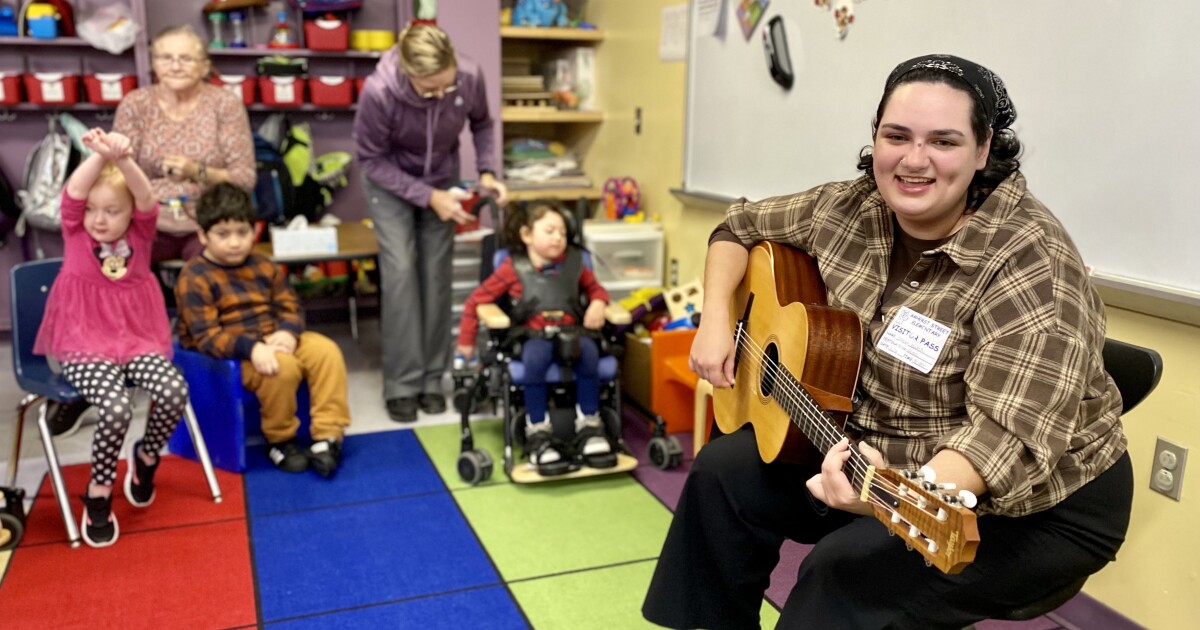
In Claremont, new staff are overseeing “resource rooms” for students struggling with behavior and academic challenges. In Nashua, a new music therapist is working with elementary schoolers with significant disabilities on communication and fine motor skills. And in Rochester, tutors are meeting with students on weekends and after school.
Thanks to federal COVID relief aid, districts have more money than usual to hire staff. Nashua and Manchester have offered signing bonuses to new hires. But there aren’t enough applicants.
Large districts in New Hampshire have dozens of open positions for paraprofessionals to work with special education students. And in many districts, the going rate for this kind of job is below what people would make at a fast food restaurant.
Bonnie Dunham, a special education advocate with the Parent Information Center, says parents who fought hard to get special education services for their kids during the pandemic are reckoning with a lack of staff to deliver some of those services.
“I have heard of a few instances where people are asking, encouraging, or begging people to come out of retirement for a little bit longer just to fill in that gap, because people want kids to get what they need,” she says.
Mackenzie Harrington-Bacote, an administrator in Rochester, says her district and many others are turning to staffing agencies to hire contract workers, including paraprofessionals. This costs the district more, but without it, they barely have any applicants.
“I’ve never experienced hiring positions where there’s truly only one candidate – that’s happening in principal positions, in teacher positions, in special ed,” she says. “We’re looking for a warm body at this point.”
In Nashua, special education director Marcia Bagley has turned to a staffing agency that hires remote workers. Now, three of its special education case managers are working remotely from other states, including Alaska. They do all their meetings via Zoom.
“If someone had said to me a year ago: ‘You’re gonna have somebody from Alaska working with you,’ I would have said you’re crazy,” she says. “But that’s the world we’re in. And I actually am very proud of the creativity we came up with to find this person.”
In Claremont, Kati O’Connell has just begun the special education evaluation process for her child, Bella. If tests reveal that she qualifies for special education, O’Connell says they’ll do whatever needs to be done. But she worries that even if the district determines Bella needs extra help, they won’t be able to hire someone to provide it.
In the face of this uncertainty, O’Connell is focused on a simple goal for her daughter: “Just to get the best help that she needs — for her to be able to be successful in school — and to be able to show the work that I know she can do.”