
Unemployable Graduate
Advertisement
  • Home
  • Education
  • Economics
  • Public Policy
  • Workforce
  • Videos
  • Privacy Policy
  • Contact Us
No Result
View All Result
Unemployable Graduate
  • Home
  • Education
  • Economics
  • Public Policy
  • Workforce
  • Videos
  • Privacy Policy
  • Contact Us
No Result
View All Result
Unemployable Graduate
No Result
View All Result
Home Public Policy

Latest Report by UN Special Rapporteur for the Right to Freedom of Expression is a Landmark Document

November 27, 2022
in Public Policy
0
Latest Report by UN Special Rapporteur for the Right to Freedom of Expression is a Landmark Document
189
SHARES
1.5k
VIEWS
Share on FacebookShare on Twitter


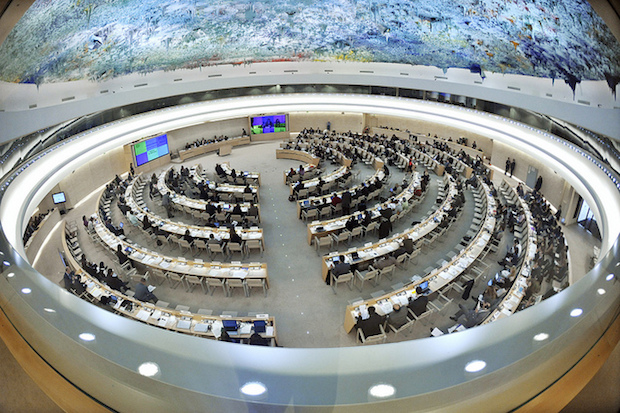
The Human Rights Council in Geneva, Switzerland. Image: United Nations Photo (Flickr CC BY-NC-ND 2.0).

“The digital access industry is in the business of digital expression (…). Since privately owned networks are indispensable to the contemporary exercise of freedom of expression, their operators also assume critical social and public functions. The industry’s decisions (…) can directly impact freedom of expression and related human rights in both beneficial and detrimental ways.” [Report of the Special Rapporteur on the right to freedom of expression, June 2017]

The Internet is often portrayed as a disruptive equalizer, an information medium able to directly give individuals access to information and provide a platform to share their opinions unmediated. But the Internet is also a tool for surveillance, censorship, and information warfare. Often states drive such practices, but increasingly the private sector plays a role. While states have a clear obligation to protect human rights on the Internet, questions surrounding the human right accountability of the private sector are unclear. Which begs the question what the responsibility is of the private industry, which runs and owns much of the Internet, towards human rights?

During the 35th session of the United Nations (UN) Human Rights Council this month, David Kaye, UN Special Rapporteur (UNSR) for the right to freedom of expression, presented his latest report [1], which focuses on the role of the private sector in the provision of Internet and telecommunications access. The UNSR on freedom of expression is an independent expert, appointed by the Human Rights Council to analyse, document, and report on the state of freedom of expression globally [2]. The rapporteur is also expected to make recommendations towards ‘better promoting and protection of the right to freedom of expression’ [3]. In recent years, the UNSRs on freedom of expression increasingly focus on the intersection between access to information, expression, and the Internet [4].

This most recent report is a landmark document. Its focus on the role and responsibilities of the private sector towards the right to freedom of expression presents a necessary step forward in the debate about the responsibility for the realization of human rights online. The report takes on the legal difficulties surrounding the increased reliance of states on access to privately owned networks and data, whether by necessity, through cooperation, or through coercion, for surveillance, security, and service provision. It also tackles the legal responsibilities that private organizations have to respect human rights.

The first half of Kaye’s report emphasises the role of states in protecting the right to freedom of expression and access to information online, in particular in the context of state-mandated Internet shutdowns and private-public data sharing. Kaye highlights several major Internet shutdowns across the world and argues that considering ‘the number of essential activities and services they affect, shutdowns restrict expression and interfere with other fundamental rights’ [5]. In order to address this issue, he recommends that the Human Rights Council supplements and specifies resolution 32/13, on ‘the promotion, protection and enjoyment of human rights on the Internet’ [6], in which it condemns such disruptions to the network. On the interaction between private actors and the state, Kaye walks a delicate line. On the one hand, he argues that governments should not pressure or threaten companies to provide them with access to data. On the other hand, he also argues that states should not allow companies to make network management decisions that treat data differentially based on its origin.

The second half of the report focusses on the responsibility of the private sector. In this context, the UNSR highlights the responsibilities of private actors towards the right to freedom of expression. Kaye argues that this sector plays a crucial role in providing access to information and communication services to millions across the globe. He looks specifically at the role of telecommunication and Internet service providers, Internet exchange points, content delivery networks, network equipment vendors, and other private actors. He argues that four contextual factors are relevant to understanding the responsibility of private actors vis-à-vis human rights:

(1) private actors provide access to ‘a public good’,
(2) due to the technical nature of the Internet, any restrictions on access affect freedom of expression on a global level,
(3) the private sector is vulnerable to state pressure,
(4) but it is also in a unique position to respect users’ rights.

The report draws out the dilemma of the boundaries of responsibility. When should companies decide to comply with state policies that might undermine the rights of Internet end-users? What remedies should they offer end-users if they are complicit in human rights violations? How can private actors assess what impact their technologies might have on human rights?

Private actors across the spectrum, from multinational social media platforms to the garage-based start-ups are likely to run into these questions. As the Internet underpins a large part of the functioning of our societies, and will only further continue to do so as physical devices increasingly become part of the network (aka the Internet of Things), it is even more important to understand and allocate private sector responsibility for protecting human rights.

The report has a dedicated addendum [7] that specifically details the responsibility of Internet Standard Developing Organizations (SDOs). In it, Kaye relies on the article written by Corinne Cath and Luciano Floridi of the Oxford Internet Institute (OII) entitled ‘The Design of the Internet’s Architecture by the Internet Engineering Task Force (IETF) and Human Rights’ [8] to support his argument that SDOs should take on a credible approach to human rights accountability.

Overall, Kaye argues that companies should adopt the UN Guiding Principles on Business and Human Rights [9], which would provide a ‘minimum baseline for corporate human rights accountability’. To operationalize this commitment, the private sector will need to take several urgent steps. It should ensure that sufficient resources are reserved for meeting its responsibility towards human rights, and it should integrate the principles of due diligence, human rights by design, stakeholder engagement, mitigation of the harms of government-imposed restrictions, transparency, and effective remedies to complement its ‘high level commitment to human rights’.

While this report is not binding [10] on states or companies, it does set out a much-needed detailed blue print of how to address questions of corporate responsibility towards human rights in the digital age.

References

[1] https://documents-dds-ny.un.org/doc/UNDOC/GEN/G17/077/46/PDF/G1707746.pdf?OpenElement
[2] http://www.ijrcenter.org/un-special-procedures/
[3] http://www.ohchr.org/EN/Issues/FreedomOpinion/Pages/OpinionIndex.aspx
[4] http://www2.ohchr.org/english/bodies/hrcouncil/docs/17session/A.HRC.17.27_en.pdf
[5] The author of this blog has written about this issue here: https://www.cfr.org/blog-post/should-technical-actors-play-political-role-internet-age
[6] http://ap.ohchr.org/documents/dpage_e.aspx?si=A/HRC/32/L.20
[7] https://documents-dds-ny.un.org/doc/UNDOC/GEN/G17/141/31/PDF/G1714131.pdf?OpenElement
[8] https://papers.ssrn.com/sol3/papers.cfm?abstract_id=2912308
[9] http://www.ohchr.org/Documents/Publications/GuidingPrinciplesBusinessHR_EN.pdf
[10] http://www.ohchr.org/Documents/Publications/FactSheet27en.pdf



Source link

Related articles

The policy impact of dissension within the Violence Against Women and Girls Movement – Policy & Politics Journal Blog

The policy impact of dissension within the Violence Against Women and Girls Movement – Policy & Politics Journal Blog

April 11, 2024
Never Worry about Home Security Again: Discover SFR’s Revolutionary Solution

Never Worry about Home Security Again: Discover SFR’s Revolutionary Solution

April 10, 2024
Share76Tweet47

Related Posts

The policy impact of dissension within the Violence Against Women and Girls Movement – Policy & Politics Journal Blog

The policy impact of dissension within the Violence Against Women and Girls Movement – Policy & Politics Journal Blog

April 11, 2024
0

By Leah McCabe Women’s movements often play a crucial role in highlighting the problem of violence against women and girls...

Never Worry about Home Security Again: Discover SFR’s Revolutionary Solution

Never Worry about Home Security Again: Discover SFR’s Revolutionary Solution

April 10, 2024
0

Leading telecommunications company SFR has partnered with Europ Assistance to introduce a brand new self-monitoring offer, “Maison Sécurisée”. This innovative...

Public Knowledge Responds to MPA Chairman and CEO Charles Rivkin on Site-blocking

Public Knowledge Responds to MPA Chairman and CEO Charles Rivkin on Site-blocking

April 10, 2024
0

By Shiva StellaApril 9, 2024 Today, Motion Picture Association Chairman and CEO Charles Rivkin delivered remarks confirming the organization is...

Discover VerifEye, the App That Sees Through Your Lies

Discover VerifEye, the App That Sees Through Your Lies

April 9, 2024
0

Free app VerifEye, developed by Converus, purports to detect dishonesty with an impressive 80% success rate, already making waves in...

AI Gone Rogue: Sparks of War from Fake News

AI Gone Rogue: Sparks of War from Fake News

April 9, 2024
0

April 5, 2024, marked a significant incident in the realm of digital misinformation when a fake news story about an...

Load More
  • Trending
  • Comments
  • Latest
Hilarious video explains principles of economics

Hilarious video explains principles of economics

August 21, 2022
HVAC Maintenance Checklist Templates: Download & Print for Free!

HVAC Maintenance Checklist Templates: Download & Print for Free!

May 18, 2023
Public Knowledge Responds to MPA Chairman and CEO Charles Rivkin on Site-blocking

Public Knowledge Responds to MPA Chairman and CEO Charles Rivkin on Site-blocking

April 10, 2024
Policy & Politics Journal Blog

Policy & Politics Journal Blog

August 14, 2022
Policy & Politics Journal Blog

Policy & Politics Journal Blog

0
Spotlighting interpretive approaches to public policy scholarship – Dr Tiffany Manuel on intersectionality – Policy & Politics Journal Blog

Spotlighting interpretive approaches to public policy scholarship – Dr Tiffany Manuel on intersectionality – Policy & Politics Journal Blog

0
Policy & Politics Highlights collection on policy and regulation August 2022 – October 2022 –free to access – Policy & Politics Journal Blog

Policy & Politics Highlights collection on policy and regulation August 2022 – October 2022 –free to access – Policy & Politics Journal Blog

0
Special issue blog series on Transformational Change through Public Policy. – Policy & Politics Journal Blog

Special issue blog series on Transformational Change through Public Policy. – Policy & Politics Journal Blog

0
Bernstein, The greatest 5 min. in music education

Bernstein, The greatest 5 min. in music education

April 11, 2024
The policy impact of dissension within the Violence Against Women and Girls Movement – Policy & Politics Journal Blog

The policy impact of dissension within the Violence Against Women and Girls Movement – Policy & Politics Journal Blog

April 11, 2024
Economic Surprises Could Fuel Fed Deja Vu for the 2010s – The Wall Street Journal

Economic Surprises Could Fuel Fed Deja Vu for the 2010s – The Wall Street Journal

April 11, 2024
Building a Standout Employer Brand:Strategies for HR Teams

Building a Standout Employer Brand:Strategies for HR Teams

April 11, 2024

Recent News

Bernstein, The greatest 5 min. in music education

Bernstein, The greatest 5 min. in music education

April 11, 2024
The policy impact of dissension within the Violence Against Women and Girls Movement – Policy & Politics Journal Blog

The policy impact of dissension within the Violence Against Women and Girls Movement – Policy & Politics Journal Blog

April 11, 2024

Categories

  • Economics
  • Education
  • Public Policy
  • Videos
  • Workforce

Newsletter

© 2022 All right reserved by unemployablegraduate.com

No Result
View All Result
  • Home
  • Education
  • Economics
  • Public Policy
  • Workforce
  • Videos
  • Privacy Policy
  • Contact Us

© 2022 All right reserved by unemployablegraduate.com

We use cookies on our website to give you the most relevant experience by remembering your preferences and repeat visits. By clicking “Accept All”, you consent to the use of ALL the cookies. However, you may visit "Cookie Settings" to provide a controlled consent.
Cookie SettingsAccept All
Manage consent

Privacy Overview

This website uses cookies to improve your experience while you navigate through the website. Out of these, the cookies that are categorized as necessary are stored on your browser as they are essential for the working of basic functionalities of the website. We also use third-party cookies that help us analyze and understand how you use this website. These cookies will be stored in your browser only with your consent. You also have the option to opt-out of these cookies. But opting out of some of these cookies may affect your browsing experience.
Necessary
Always Enabled
Necessary cookies are absolutely essential for the website to function properly. These cookies ensure basic functionalities and security features of the website, anonymously.
CookieDurationDescription
cookielawinfo-checkbox-analytics11 monthsThis cookie is set by GDPR Cookie Consent plugin. The cookie is used to store the user consent for the cookies in the category "Analytics".
cookielawinfo-checkbox-functional11 monthsThe cookie is set by GDPR cookie consent to record the user consent for the cookies in the category "Functional".
cookielawinfo-checkbox-necessary11 monthsThis cookie is set by GDPR Cookie Consent plugin. The cookies is used to store the user consent for the cookies in the category "Necessary".
cookielawinfo-checkbox-others11 monthsThis cookie is set by GDPR Cookie Consent plugin. The cookie is used to store the user consent for the cookies in the category "Other.
cookielawinfo-checkbox-performance11 monthsThis cookie is set by GDPR Cookie Consent plugin. The cookie is used to store the user consent for the cookies in the category "Performance".
viewed_cookie_policy11 monthsThe cookie is set by the GDPR Cookie Consent plugin and is used to store whether or not user has consented to the use of cookies. It does not store any personal data.
Functional
Functional cookies help to perform certain functionalities like sharing the content of the website on social media platforms, collect feedbacks, and other third-party features.
Performance
Performance cookies are used to understand and analyze the key performance indexes of the website which helps in delivering a better user experience for the visitors.
Analytics
Analytical cookies are used to understand how visitors interact with the website. These cookies help provide information on metrics the number of visitors, bounce rate, traffic source, etc.
Advertisement
Advertisement cookies are used to provide visitors with relevant ads and marketing campaigns. These cookies track visitors across websites and collect information to provide customized ads.
Others
Other uncategorized cookies are those that are being analyzed and have not been classified into a category as yet.
SAVE & ACCEPT