
The marine bounty of the Salish Sea near the Stanwood and Camano Island area has been harvested for thousands of years.
Archaeological evidence shows that the Indigenous people’s way of life included fishing, clamming and gathering a variety of aquatic life from the waterways of northern Puget Sound.
With the arrival of Euro-Americans in the Stillaguamish Valley in the 1800s and the ensuing 1855 Treaty of Point Elliot, embattled tribes ceded the land which also resulted in diminished access to much of the water’s abundance.
New arrivals, many of whom were from Scandinavia, came with a vast knowledge of fishing and as a result, the harvesting of species like salmon boomed through the 1800s and much of the first part of the 1900s.
Beginning in the 1920s, the popularity of recreational fishing, for salmon and other species, resulted in the establishment of nearly two dozen waterfront resorts in the area.
As the 20th century continued, issues such as poor species management, pollution, climate change and an historic ruling that reaffirmed the fishing rights of Indigenous people drastically changed the seascape.
In recent decades, state agencies, the area’s Tribal natural resource divisions and other groups have worked to restore habitat and rebuild many of the area’s marine resources.
Over 6,000 years ago, Indigenous people, today known as the Coast Salish, began living in what is present-day western Washington and southwestern British Columbia.
The Coast Salish took advantage of the area’s many natural resources that included plants, game and marine life.
The culture of the northern Puget Sound Indigenous people, which included Lower Skagit, Kikiallus, Stillaguamish, Snohomish, Snoqualmie, Skagit, Suiattle and Samish people, was forever changed with the arrival of Euro-Americans in the 19th century who began to develop the land.
The 1855 Treaty of Point Elliot was a land settlement between Tribes and the United States government that established reservations and guaranteed, “The right of taking fish at usual and accustomed grounds.”
However, as time went on, these rights were subjugated as Indigenous people were moved to reservations and others began reaping the aquatic resources.
Many of the first Euro-Americans arriving in the Stillaguamish Valley were from Sweden, Norway and Finland—all with a long history of fishing in the icy fjords surrounding their countries.
The new arrivals saw the abundance and for much of the second half of the 1800s, salmon populations, in particular, were thought to be an inexhaustible resource and were fished extensively throughout the Pacific Northwest.
According to the University of Washington Libraries website, “Fishermen utilized many methods to ensnare salmon, including fishwheels, horse seining, gillnets, and traps. In the early years, these practices were mostly unregulated and left to the determination of the fishermen themselves.”
In 1883, the development of fish canning technology allowed for the greater transporting of product and increased the market potential.
Seafood processing in Stanwood
In “The Stanwood Story: Volume I,” author Alice Essex wrote that in 1898, “…the Friday Fish Company marked the beginning of the commercial fishing business at the mouth of the Stillaguamish River”
Essex wrote that the salmon cannery, which was near where Twin City Foods is located today at 10130 269th Place NW, had a capacity of “4,000 to 5,000 cases a day and employed 50 men.”
Another Stanwood fish cannery opened in 1917 on the Stanwood waterfront and Essex wrote that, “…an all-day run totaled 500 cases of Chinook salmon with a crew of six men and 18 girls.”
In addition to salmon, local oyster production was pursued.
The Stanwood Area Historical Society’s March 2005 Echoes publication lays out the rise and fall of the Camano Blue Point Oyster Company that was established in the early 1930s.
According to the article, George Kosmos bought, “5300 acres of tideland between Juniper Beach and Livingston Bay [on Camano Island] of which 3500 acres were suitable for growing oysters.”
Kosmos planted thousands of seed oyster from Japan and in 1932, “the first scowload of oysters was towed from Livingston Bay to the Stanwood wharf” where they were shucked and sent by refrigerated truck to Seattle.
The Kosmos oyster endeavor was ultimately unprofitable.
According to the Echoes article, in January of 1940, “…the Cooperative Food Products announced that it would be taking over the Blue Point building to specialize in the canning of rabbits and fish.”
The Gaetz Oyster Company took another crack at the bivalve and purchased the Blue Point tide flats near Livingston Bay in 1943 and began processing the shellfish on the wharf in Stanwood.
In the early 1940s, oyster beds were also cultivated near Stanwood—Essex wrote that 10,000 seed oysters were planted, “on 1,000 acres of second class tidelands at Warm Beach.”
According to the Echoes article, in 1947 an oil spill in Port Susan from, “…the bow of a broken Russian tanker full of oil…” that had been towed to the area contaminated local oyster beds and brought an end to the area’s shellfish industry.
Frontier way being replaced
In the early part of the 1900s, as fish population declined, many devices, such as fish wheels, were banned because they were so effective at depleting species.
Over time, a variety of additional commercial and recreational government regulations were put in place such as limiting catch amounts, regulating fishing seasons and requiring licenses for certain fisheries.
Many of the restrictions were met with resistance.
Essex wrote that a 1907 bill introduced in Olympia that would have required, in part, citizens to pay for hunting and fishing licenses was met with a local petition protesting the taking away of rights “…guaranteed by every law passed by the State or the United States.”
Essex concluded, “And so it was in those days of transition, when the ways of the frontier were gradually being replaced by new rules of conduct.”
In the early decades of the 1900s, as commercial fishing increasingly moved north to more abundant waters, recreational fishing grew in popularity.
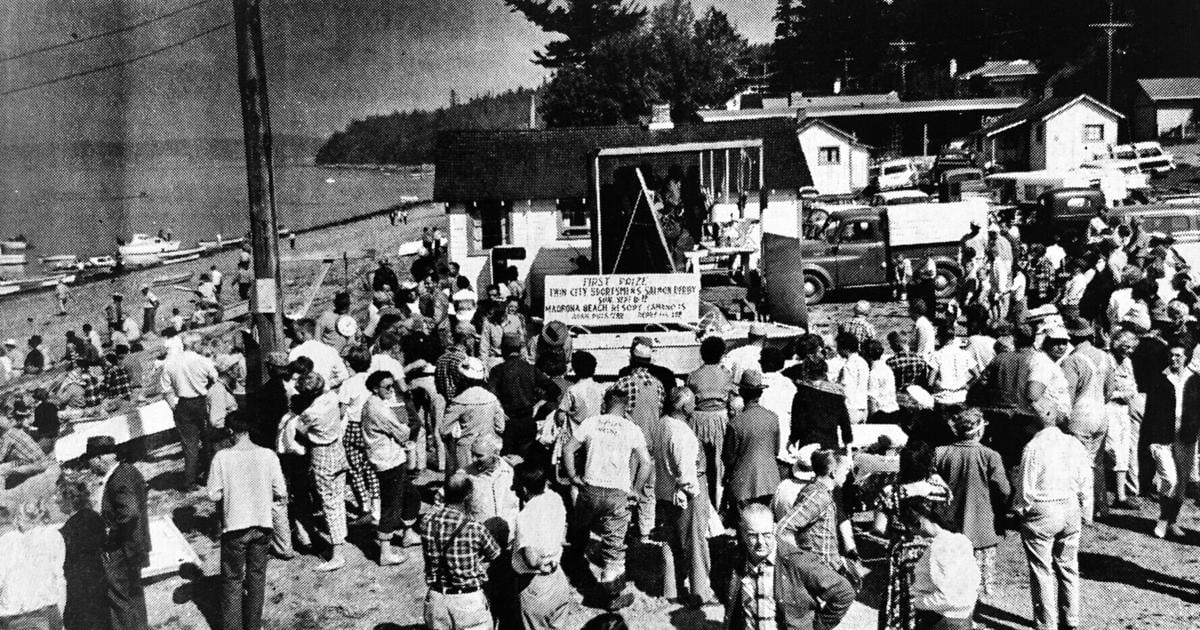
“Between 1920 and 1960, about 20 resorts were established, often changing owners many times, providing fishing boats and cabins for vacation rental,” Karen Prasse wrote in her history book, “Camano Island.”
The Camano resorts became renowned for outfitting vacationers for successful salmon fishing junkets.
According to a 2011 report by the Center for Wooden Boats, in its heyday of the 1950s, the Cama Beach Resort had one of the largest fleet of rental boats for sports fishing in the area.
Fishing derbies sponsored by many of the resorts offering hundreds of dollars in prize money were a big draw.
Local author Jason Dorsey’s book, “The Beaches of Camano Island,” describes a successful derby catch, “Fishermen from the resort at Tyee Beach fished Camano Head, and Anita Moore caught a 25-pound King salmon there in August of 1925.”
According to Stanwood Camano News archives, in 1962 Bethel Blendheim reeled in a 53-pound king salmon off the west side of Camano Island—a record size for the area.
By the 1970s, changing vacation habits and the further decline of West Coast salmon runs resulted in many resorts giving way to private development or closing down as business dwindled.
A paradigm shift to areas waters occurred in 1974 when a ruling by Federal Judge George Boldt reaffirmed the rights of Washington’s Tribes to fish in accustomed places.
According to KIRO News Radio Resident Historian Feliks Banel, the outcome of legal action changed the way fisheries were managed in Washington State.
“The Boldt Decision forced the state government to recognize tribal fishing rights and tribal sovereignty,” Banel said. “It essentially split the annual fisheries harvest between tribes and non-tribal sport anglers and the commercial fish industry.”
Kadi Bizyayeva, fisheries director of the Stillaguamish Tribe of Indians, said that there are pros and cons to the Boldt Decision.
“The Bold Decision reaffirmed that Washington Tribes had a right to take 50 percent of the harvestable surplus,” she said. “Unfortunately due to the fact that Puget Sound Chinook stocks have been plummeting and are now regulated under the Endangered Species Act, we no longer have access to a true ‘harvestable surplus’ of Chinook.”
Chase Gunnell, Puget Sound Region communication manager for the Washington Department of Fish and Wildlife, is well-familiar with the issues affecting marine life, particularly indicator species like Pacific salmon.
“Many wild salmon and steelhead stocks are currently returning at a fraction of historical abundance due to habitat loss, historic overfishing, barriers blocking access to spawning habitat, and other factors,” he said.
Gunnell said that work is underway to reverse the trend.
“Ongoing efforts to restore habitat and improve fish passage offer reason for hope in Snohomish County and beyond,” he said. “In recent years, WDFW has been working collaboratively with counties, tribes, local landowners and other partners to restore estuary habitat, including at sites around Stanwood such as Leque Island and Wiley Slough.
Bizyayeva is also optimistic about the restoration of local estuaries.
“The work we’ve done to restore the Stillaguamish estuary on projects such as Zis-a-Ba near Stanwood is really paying off,” she said. “We are already seeing juvenile Chinook utilizing the habitat, and are certain these projects will be beneficial for both our salmon and local stakeholders.”
Jeff Fernandes, 65, who grew up in Stanwood has been fishing in local waters for most of his life.
“When I was a teen, we’d go out early and launch south of town to fish for silvers,” he said. “Usually by lunch, we would all have our limit of three apiece—they would be anywhere four to ten pounds.”
Not so much today, he said.
“Honestly, I don’t really do much saltwater fishing anymore,” Fernandes said. “Between the government regulations and dismal state of most species, it’s just not worth it to go out and get nothing.”
However, Gunnell remains steadfastly optimistic.
“It will take decades to recover salmon habitat and many challenges remain but there’s still plenty of reasons for hope,” he said. “Through careful fisheries management, science-based habitat restoration, and by working together, we can sustain the natural heritage that makes the Puget Sound region so special.”
“It took over 150 years for marine habitat to reach its current state,” she said. “I am very hopeful that if we all work together we can restore these amazing waters that we share.”
* Mary Jennings is a regular contributor to the Stanwood Camano News.