
Downtowns are every city’s long-term, never-ending project.
They’re a fantasy of economic ecstasy.
Think San Luis Obispo is the only place that’s on the struggle bus? Guess again.
Even the city of Santa Barbara with its high-end chain stores and fancy-pants restaurants and wineries is champing at the bit for change. The bougiest city on the Central Coast wants to “revitalize” its colonial Spanish-style downtown by increasing foot traffic, decreasing criminal activity, and spurring retail development.
There’s too many homeless people, you know? Not enough money. Such a drag, right?
How do cities change that?
Tourism, apparently. A proposal to build 36 units of housing in downtown Santa Barbara turned into a 45-unit hotel project after the developer ran up against affordable housing and parking requirements. Who did he blame? The city, obviously—as if Santa Barbara’s economic fate isn’t tied to the rest of the universe.
Has he been to Santa Maria? That city allows all kinds of development and still can’t pull its downtown together. It’s been trying for decades. You know whose fault it is there, don’t you? It’s definitely not parking. Santa Maria’s downtown is basically one giant parking lot.
It’s the mall. We all need a beast to pen our demons inside of, you know?
“We don’t need any concessions for a hotel,” the housing-turned-hotel developer told Noozhawk in December 2022. “At this point in time, hotels have a lot more value than apartments.”
What are you saying? Tourists have more cash than locals? No, no. He’s saying that building something for residents is too onerous. Because residents have needs that developers are required to actually meet. Things like affordability, parking, and city services (which developers have to pay fees for).
Hotel guests only need three hots and a cot—and they’re paying for all of them, alongside transient occupancy tax to the city. A triple threat, amirite? Must be the perfect solution!
Bring on the cash! Bring on the upscale retail! Down with the vagrants! I can feel the economic growth from here. It will pave the streets with gold.
How’s that going in SLO? This little city—aka, “small-town America” (according to opinion writer Christine Mulholland)—is drowning in new hotels. We’ve got Hotel SLO, Hotel Cerro, the Granada Hotel, and the SLO Brew Lofts—all relatively recent developments that have just spurred retail development in a thriving downtown SLO, right?
Wrong. Storefronts are still empty, and “bougie” restaurants continue to open with hopes of striking it rich off all those upscale tourists who can pay $300 a night or more for a hotel room. Those dollar bill dreams get crushed regularly, and our culinary friends often have to close up shop. And guess what? No gold.
What’s the problem? Parking! According to everyone who’s never lived anywhere where parking is truly an issue. College students! According to people who don’t understand that they’re one of the only things keeping downtown alive. It’s certainly not visitors to Mission San Luis Obispo de Tolosa or the Dalidet Adobe.
It’s the boozers with their parents spending money. Duh.
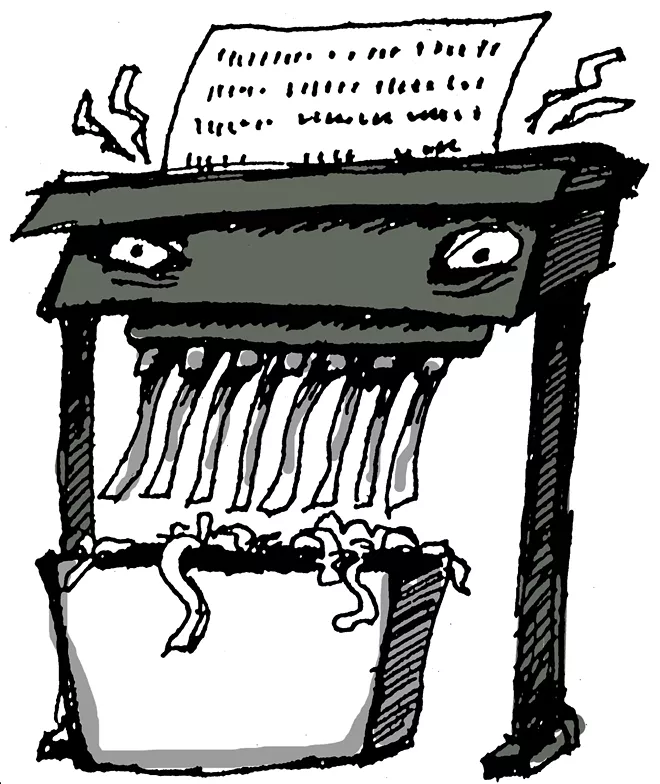
I’m just a creaky old office appliance, so what do I know, but catering everything to tourism is not the way to sustain a city. It could be that the lifestyle everyone covets, the wineries that breathe money into the Edna Valley, and all the foodie culture that comes with it don’t actually pay everyone’s bills. It could be that a lack of affordable housing—actually, a lack of housing altogether—is a big problem. It could be the area doesn’t have any sort of industry that pays a living wage. It could be that the problem is bigger than a single city can solve.
But what kind of attitude is that?
We’re a can-do kind of place! SLO is the happiest little city that could, and SLO’s residents are all for new ideas to revitalize downtown. Right? Umm. Nope. Not even close.
The city’s come up with a bright idea to try and inject development into its downtown core. A new ordinance would allow a higher housing housing density for units up to 600 square feet. It caps that development at 500 units or in 2029, whichever comes first, and waives inclusionary housing and parking requirements.
It sounds like an excellent idea. A bunch of studios and one-bedrooms above bustling Higuera, Monterey, and Palm streets. As city Community Development Director Michael Codron puts it, the program should attract smaller, denser, and—hopefully—more affordable housing. And retail and restaurants along the way.
Who are we kidding? There won’t be anything affordable about these apartments. But maybe it will free up some of the city’s aging, shitty housing stock for the rest of us bums.
One resident was concerned about SLO’s “small-town feel that people come here to visit,” as well as parking. Ride a bike! Hey anonymous resident scared about parking, no one is going to visit Bubble Gum Alley or your small town if all the restaurants close. But, hey, parking won’t be an issue.
Mulholland wrote in her opinion (again, page 10) that “density isn’t a panacea.” But nothing is a panacea. At least density is something. And we need all the something’s we can get: tourism, housing, retail, restaurants, and parking. ∆
The Shredder is parked in a New Times’ spot. Send coins to shredder@newtimesslo.com.