
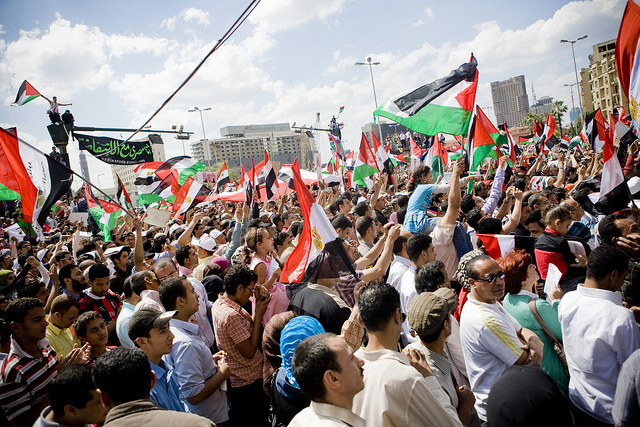
Online activism has become increasingly visible, with social media platforms being used to express protest and dissent from the Arab Spring to #MeToo. Scholarly interest in online activism has grown with its use, together with disagreement about its impact. Do social media really challenge traditional politics? Some claim that social media have had a profound and positive effect on modern protest — the speed of information sharing making online networks highly effective in building revolutionary movements. Others argue that this activity is merely symbolic: online activism has little or no impact, dilutes offline activism, and weakens social movements. Given online activity doesn’t involve the degree of risk, trust, or effort required on the ground, they argue that it can’t be considered to be “real” activism. In this view, the Arab Spring wasn’t simply a series of “Twitter revolutions”.
Despite much work on offline social movements and coalition building, few studies have used social network analysis to examine the influence of brokers of online activists (i.e. those who act as a bridge between different ideological groups), or their role in information diffusion across a network. In her Policy & Internet article “Brokerage Roles and Strategic Positions in Twitter Networks of the 2011 Egyptian Revolution”, Deena Abul-Fottouh tests whether social movements theory of networks and coalition building — developed to explain brokerage roles in offline networks, between established parties and organisations — can also be used to explain what happens online.
Social movements theory suggests that actors who occupy an intermediary structural position between different ideological groups are more influential than those embedded only in their own faction. That is, the “bridging ties” that link across political ideologies have a greater impact on mobilization than the bonding ties within a faction. Indeed, examining the Egyptian revolution and ensuing crisis, Deena finds that these online brokers were more evident during the first phase of movement solidarity between liberals, islamists, and socialists than in the period of schism and crisis (2011-2014) that followed the initial protests. However, she also found that the online brokers didn’t match the brokers on the ground: they played different roles, complementing rather than mirroring each other in advancing the revolutionary movement.
We caught up with Deena to discuss her findings:
Ed: Firstly: is the “Arab Spring” a useful term? Does it help to think of the events that took place across parts of the Middle East and North Africa under this umbrella term — which I suppose implies some common cause or mechanism?
Deena: Well, I believe it’s useful to an extent. It helps describe some positive common features that existed in the region such as dissatisfaction with the existing regimes, a dissatisfaction that was transformed from the domain of advocacy to the domain of high-risk activism, a common feeling among the people that they can make a difference, even though it did not last long, and the evidence that there are young people in the region who are willing to sacrifice for their freedom. On the other hand, structural forces in the region such as the power of deep states and the forces of counter-revolution were capable of halting this Arab Spring before it burgeoned or bore fruit, so may be the term “Spring” is no longer relevant.
Ed: Revolutions have been happening for centuries, i.e. they obviously don’t need Twitter or Facebook to happen. How significant do you think social media were in this case, either in sparking or sustaining the protests? And how useful are these new social media data as a means to examine the mechanisms of protest?
Deena: Social media platforms have proven to be useful in facilitating protests such as by sharing information in a speedy manner and on a broad range across borders. People in Egypt and other places in the region were influenced by Tunisia, and protest tactics were shared online. In other words, social media platforms definitely facilitate diffusion of protests. They are also hubs to create a common identity and culture among activists, which is crucial for the success of social movements. I also believe that social media present activists with various ways to circumvent policing of activism (e.g. using pseudonyms to hide the identity of the activists, sharing information about places to avoid in times of protests, many platforms offer the possibility for activists to form closed groups where they have high privacy to discuss non-public matters, etc.).
However, social media ties are weak ties. These platforms are not necessarily efficient in building the trust needed to bond social movements, especially in times of schism and at the level of high-risk activism. That is why, as I discuss in my article, we can see that the type of brokerage that is formed online is brokerage that is built on weak ties, not necessarily the same as offline brokerage that usually requires high trust.
Ed: It’s interesting that you could detect bridging between groups. Given schism seems to be fairly standard in society (Cf filter bubbles etc.) .. has enough attention been paid to this process of temporary shifting alignments, to advance a common cause? And are these incidental, or intentional acts of brokerage?
Deena: I believe further studies need to be made on the concepts of solidarity, schism and brokerage within social movements both online and offline. Little attention has been given to how movements come together or break apart online. The Egyptian revolution is a rich case to study these concepts as the many changes that happened in the path of the revolution in its first five years and the intervention of different forces have led to multiple shifts of alliances that deserve study. Acts of brokerage do not necessarily have to be intentional. In social movements studies, researchers have studied incidental acts that could eventually lead to formation of alliances, such as considering co-members of various social movements organizations as brokers between these organizations.
I believe that the same happens online. Brokerage could start with incidental acts such as activists following each other on Twitter for example, which could develop into stronger ties through mentioning each other. This could also build up to coordinating activities online and offline. In the case of the Egyptian revolution, many activists who met in protests on the ground were also friends online. The same happened in Moldova where activists coordinated tactics online and met on the ground. Thus, incidental acts that start with following each other online could develop into intentional coordinated activism offline. I believe further qualitative interviews need to be conducted with activists to study how they coordinate between online and offline activism, as there are certain mechanisms that cannot be observed through just studying the public profiles of activists or their structural networks.
Ed: The “Arab Spring” has had a mixed outcome across the region — and is also now perhaps a bit forgotten in the West. There have been various network studies of the 2011 protests: but what about the time between visible protests .. isn’t that in a way more important? What would a social network study of the current situation in Egypt look like, do you think?
Deena: Yes, the in-between times of waves of protests are as important to study as the waves themselves as they reveal a lot about what could happen, and we usually study them retroactively after the big shocks happen. A social network of the current situation in Egypt would probably include many “isolates” and tiny “components”, if I would use social network analysis terms. This started showing in 2014 as the effects of schism in the movement. I believe this became aggravated over time as the military coup d’état got a stronger grip over the country, suppressing all opposition. Many activists are either detained or have left the country. A quick look at their online profiles does not reveal strong communication between them. Yet, this is what apparently shows from public profiles. One of the levers that social media platforms offer is the ability to create private or “closed” groups online.
I believe these groups might include rich data about activists’ communication. However, it is very difficult, almost impossible to study these groups, unless you are a member or they give you permission. In other words, there might be some sort of communication occurring between activists but at a level that researchers unfortunately cannot access. I think we might call it the “underground of online activism”, which I believe is potentially a very rich area of study.
Ed: A standard criticism of “Twitter network studies” is that they aren’t very rich — they may show who’s following whom, but not necessarily why, or with what effect. Have there been any larger, more detailed studies of the Arab Spring that take in all sides: networks, politics, ethnography, history — both online and offline?
Deena: To my knowledge, there haven’t been studies that have included all these aspects together. Yet there are many studies that covered each of them separately, especially the politics, ethnography, and history of the Arab Spring (see for example: Egypt’s Tahrir Revolution 2013, edited by D. Tschirgi, W. Kazziha and S. F. McMahon). Similarly, very few studies have tried to compare the online and offline repertoires (see for example: Weber, Garimella and Batayneh 2013, Abul-Fottouh and Fetner 2018). In my doctoral dissertation (2018 from McMaster University), I tried to include many of these elements.
Read the full article: Abul-Fottouh, D. (2018) Brokerage Roles and Strategic Positions in Twitter Networks of the 2011 Egyptian Revolution. Policy & Internet 10: 218-240. doi:10.1002/poi3.169
Deena Abul-Fottouh was talking to blog editor David Sutcliffe.