

Thinking Outside the Job
Current Ways of Working
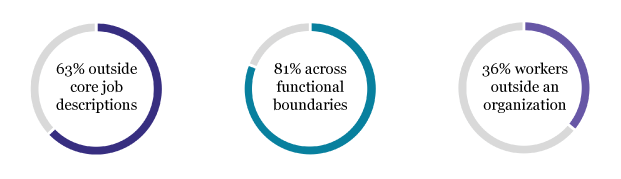
Our perception of work is changing almost daily. How employees and independent professionals achieve success is also changing. A recent Deloitte survey reported that many organizations are increasingly placing “skills” instead of “jobs” at the core of how work gets done today. The survey found that 63% of current work falls outside people’s core job descriptions, 81% is performed across functional boundaries, and 36% is performed by workers outside an organization. While open employee positions and independent talent searches may still use job or role descriptions as a foundation, enterprises are focusing more and more on skills as the basis for talent management. Skills-based organizations, in fact, are future-proofing the business. The skills-based organization is positioned for future success in the business and in its talent pool.
Focusing on Soft Skills

AI and other technologies are transforming the world of work, and today’s workforce will need to continuously learn new skills as different occupations and ways of working emerge. Experts cannot yet clearly define which specific roles will be lost and what new roles will materialize in the automated workplace. Many of the skills that will be needed, on the other hand, can be characterized.
Certain skills are uniquely human and cannot be replaced by automation (at least for now). When working in concert with work-specific skills, other skills—what we’ve traditionally called soft skills and today can be thought of as human skills—will help your talent navigate the evolving landscape, lay a solid foundation for professional growth, and enrich their lives beyond the workplace. Critical thinking, creativity, and communication are three examples of a range of soft skills the AI has yet to master.
Hiring for proficiency in soft skills will help future-proof the enterprise. These human skills are independent of the type of work or organizational function.
Assessing Soft Skills at 30,000 Feet
Whether you are hiring an employee or engaging an independent professional, here are some ways to screen for soft skills:

In the Interview
Whether interviewing in person or online, stay alert for nonverbal cues. Were they on time for the appointment? If not, did they let you know ahead of time that they would be late? Do they generally maintain eye contact with you? Are they asking questions based on your conversation? Even their ability to deal with technology glitches during a virtual interview can give you some insight into how they will operate in your organization.
Talking to References
Request references from former colleagues as well as former managers. Managers can provide insight into areas like problem-solving, conflict resolution, and coachability. Former colleagues may be able to give you a picture of the candidate’s collaboration style, how they handled stress, uncertainty, or unexpected challenges, and how well they interacted with other team members.
Browsing Social Media
Work-focused platforms like LinkedIn can add to your insight about a candidate. Go past the experience list in the profile and look at posts, comments, and any articles they have published.
Taking a Deeper Dive
The list of soft skills that are valuable in the workplace is pretty long. These four are a good starting point for hiring and engaging talent with the future of work in mind:
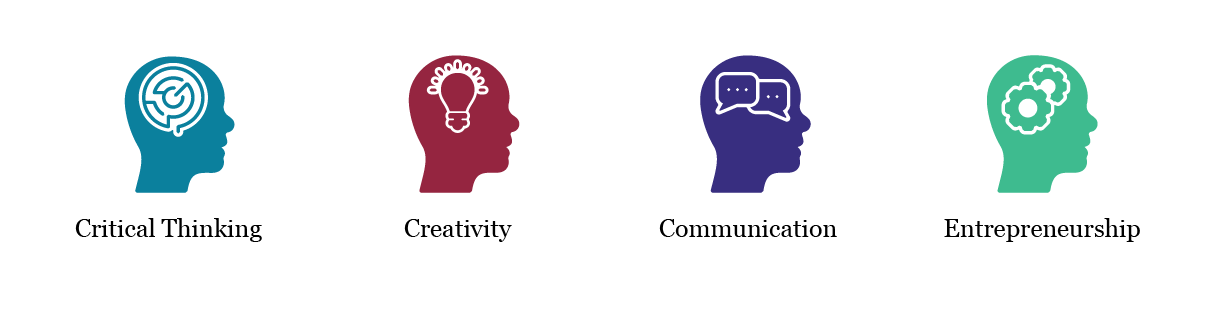
- Critical thinking
- Creativity
- Communication
- Entrepreneurship
 1. Critical Thinking
Critical thinking is the ability to analyze available facts, evidence, observations, and arguments to form a judgment free of bias or assumptions. It is front and center in situations like:
- Anticipating problems and proactively preventing them
- Designing solutions for challenges
- Creating streamlined, efficient work processes
- Gauging demand there for a product or service based on industry data and trends
- Delegating tasks effectively
Critical thinking is the friend of data, metrics, and analysis. People who apply this skill make well-reasoned arguments based on fact, without emotion involved, using:
- Logic – Critical thinkers can consider a situation from every angle and use logic to develop a solution to a problem.
- Discipline – They can discern their own biases and assumptions and set them aside.
- Innovation – They look at problems from a different perspective, so can come up with fresh solutions.
8 CHARACTERISTICS OF CRITICAL THINKERS
In the workplace, critical thinkers can be spotted through a range of characteristics. For example, they:
- Ask questions and look for the best available information.
- Are more interested in getting something right than in being the one who is right.
- Take time to better understand a situation before acting or making a decision.
- Ask questions to understand reasons behind the data being presented.
- Look for patterns in the data and avoid forcing information to fit a desired conclusion.
- Are continuous learners and inquisitive about a variety of topics.
- Are willing to consider alternative ideas and opinions.
- Can clearly explain how they arrived at a conclusion.
Notice the ways in which the employees and independent talent on your team interact, approach problems and challenges, and present solutions. Are there critical thinkers among them? If so, find ways cultivate and nurture them.
HIRING CRITICAL THINKERS
Incorporate questions and requests about critical thinking into your interviews of potential employees and contractors. Queries like these can help you gauge how a candidate uses (or doesn’t use) critical thinking.
How do you make a decision when you can’t access all the information?
Assess how the person thinks within limitations. Look for their use of logic and ingenuity to reach a decision. Ask for an example from their experience.
What was a difficult work-related decision you had to make?
Understand the thought process behind the decision and how the person applied critical thinking to figure out options and select the solution.
Talk about a time when you had to make a decision immediately.
Gauge the person’s approach in a time- and information-bound situation. Note how they applied logic and reasoning under pressure.
How would you engage with a colleague who presented a solution that is different from yours?
Listen for the person’s ability to be open-minded and how they consider new ideas offered by other team members.
Talk about a big goal you set for yourself and how you achieved it.
Listen along to lines to this response. First, the actual process they went through and, second, how they explain it to you.
 2. Creativity
Creativity is a precursor to innovative solutions that meet customers’ needs, streamline operations, boost productivity, and galvanize the worker experience. Hire creativity into your optimized workforce and your organization can see big results.
Creativity in an enterprise is foundational, permeating every department and workflow. Research has shown greater financial performance—as much as two-thirds higher than average—in firms that encourage creativity in the workforce (the majority of the world’s most innovative organizations are also the most valuable). And while in addition to linking to innovation, creativity in your talent—whether employee or independent—generates a lot of other business benefits.
An organizational culture that fosters creativity encourages collaboration and teamwork. Workers can work together to brainstorm new ideas and think critically to devise new solutions to complex challenges. The latitude to apply creativity to the job can improve productivity, support worker wellness, and increase motivation. In turn, the company can improve workflows in operations, achieve new revenue streams, and take a more advantageous competitive position in its markets.
7 CHARACTERISTICS OF A CREATIVE WORKER
Day-to-day creativity in the workplace can be spotted in the ways people work and interact. Creative workers:
- Collaborate effectively with colleagues
- Ask questions to help them understand others’ ideas
- Share their ideas for improving processes or operations
- Are willing to take risks to test and refine ideas
- Question “the way we do things here”
- Are comfortable with ambiguity
- Learn from constructive feedback
Many high-value independent professionals have developed these characteristics in the course of the projects they work on and the teams they participate in. Engaging independent talent that demonstrate creativity can pay dividends through increased motivation, productivity, and output in the areas where they work
HIRING FOR CREATIVITY
Including interview questions about creativity can help you gauge this soft skill in your potential contractors. Here are some to consider. In all cases, actively listen and ask follow up questions to get deeper detail.
How do you handle situations where colleagues don’t understand your creative ideas?
This question can help shed light on how the candidate helps others grasp creative ideas and how they use the need for better understanding to refine or explain the idea.
How have you inspired a client or team to be more creative?
This answer can give you insight into how the candidate interacts with others and their effectiveness in fostering creativity among colleagues and clients.
Tell me about creatively solving a problem to get the job done.
In addition to listening to their story, note the story they choose. For example, they might offer details related to a project they were hired for, which can illustrate their willingness to take risks in client engagements when there is a chance of a good outcome. Or they might describe addressing a challenge in their own company, which can give you a view of how they use creativity to help them grow business.
Tell me about achieving buy-in from a client or team for an out-of-the-box idea.
This turns up the heat a bit in terms of turning an idea into reality. Achieving buy-in can mean the allocation of resources and a commitment from management to the idea. Make note of how the candidate was able to move the needle in favor of the idea and what was the final result.
Do you have a process to include creativity in a problem-solving session? If so, describe it.
There are a lot of exercises that help foster creativity in a group setting. See what exercises the client has used and how well they worked to solve problems.
What has been the biggest success resulting from your creative approach?
This question will likely be answered with great enthusiasm and detail. If possible, get quantitative results like sales increase, cost savings, or time savings.
 3. Communication
While communication skills have always been important in the workplace, the advent of AI makes them even more significant. While some forms of communication can be taught to AI tools, others are uniquely human.
The quality of communication on your team can significantly affect productivity and project outcomes. Ensure that the independent talent you bring on board are accomplished communicators, particularly in the areas that AI can’t touch.
The four main types of communication are:
- Written, which includes formal (e.g., reports, white papers, some emails) and informal (e.g., chat messages, some emails)
- Verbal, including conversations with and among team members and presentations/public speaking, in person and virtually
- Non-verbal, including behavioral and body cues, in personal and virtually
- Visual, using graphics and other visual media to convey a message
AI can be trained to use some kinds of written communication. ChatGPT is a current example, and using AI-driven chatbots have been in use for some time. However, as of yet, AI cannot create communications that lie outside the parameters built into it. And though it can analyze information and be taught how to respond in certain scenarios, it cannot synthesize new responses that may be needed in some cases. As far as verbal, non-verbal, and visual communication, AI isn’t yet a player in those areas.
In the evolving workplace where AI will be increasingly present, it is important to hire independent talent with well-developed communication skills across all types.
7 CHARACTERISTICS OF EFFECTIVE COMMUNICATORS
In the workplace, these seven characteristics are valuable contributors to team productivity and project outcomes.
- Stays on message – In written and verbal communications, the writer or speaker stays focused on the topic being addressed. They are clear, succinct, and to the point.
- Matches the medium to the message -The medium used can depend on the message being conveyed. Verbal communication can be the best medium for messaging that requires immediate two-way interaction. Quick questions or information sharing among team members can be best suited to chat spaces like Slack. A competent communicator uses the best medium for the message.
- Accepts and provides useful feedback -Accepting and providing feedback is an essential workplace skill. Strong communicators can accept constructive feedback and provide constructive input to others. They ask and answer relevant questions and offer specific examples that bear on the feedback.
- Shows empathy – This communication skill is important in both team and one-on-one interactions. Effectively reading and understanding a person’s reactions and emotions, often expressed nonverbally, allow responses that acknowledge their position. This can help the interaction continue to move in a productive direction.
- Responds quickly -Whether returning a phone call or replying to an email, a quick response is valuable. Skilled communicators respond to messages in a timely manner. Even when a full response takes time, they acknowledge receipt of the message and let the originator know when they can expect the longer answer.
- Actively listens -Active listening requires close engagement with the person communicating. Active listeners pay attention to what is being said and how it is being delivered. They repeat or rephrase along the way to get confirmation that they accurately understand and ask questions as needed to gain clarity.
- Applies critical thinking -Extending active listening across all communication types, a skilled communicator will analyze facts and observations. If needed they will engage further with the message originator to ensure accuracy and relevance based on their analysis.
HIRING FOR COMMUNICATION
Here are some interview questions that can help demonstrate communication skills in your potential contractors.
How do you prefer to communicate at work?
There are two points to note. First, does their preference work for the role they will fill? Second, do they talk about matching the medium to the message, that is, having preferences that vary according to the communication?
You’ve made a mistake that affects another team member. How would you let them know?
In most situations, this kind of communication requires live verbal communication, preferably in person or virtually. Not how the interviewee would approach the issue. Ask for real-life examples where they’ve either been the recipient or originator. Pay attention to how things were resolved.
How would you work with a team member who is uncomfortable with verbal communication?
Find out what options the candidate would pursue to accommodate the team member or encourage them to express themselves verbally.
Tell me about a work situation where non-verbal communication played a key role in outcomes.
The response to this request can help you assess how tuned in to non-verbal communication the candidate is and whether they can use their observations to adjust what’s being said to achieve a desired outcome.
How would you explain a complex issue to a new team member?
The response to this question can provide a lot of insight into the candidate’s skills. How do they propose to use different types of communication in their explanation? Will they encourage questions? How will they ensure that the explanation is understood?
 4. Entrepreneurship
As digital and AI technologies continue to transform the world of work, the future workforce will need to be nimble, adaptable, and comfortable with continuous change. These attributes and the soft skills we’ve considered here can be summed up in one word: entrepreneurship.
Independent professionals tend to be entrepreneurial by nature, which can be a big advantage to your enterprise. When your workforce is optimized through a strategic mix of employees and independents, you can tap into the innate entrepreneurial perspectives of your direct sourcing talent network. This can help effect changes in culture to align with the technology-driven future of work.
5 CHARACTERISTICS OF ENTREPRENEURIAL WORKERS
Combining critical thinking, creativity, and excellent communication skills, entrepreneurial workers exhibit these characteristics:
- They are high-energy individuals – These are noticeable people because of the energy they exude. They work hard and with passion.
- They love creative challenges -Entrepreneurial workers thrive when presented with a challenge, and the more creative the challenge the better.
- They proactively offer new ideas -Whether they come up with a process improvement, a tweak to a product design, or a way to expand the business, entrepreneurial workers don’t wait to be asked.
- They are action-oriented -While they are certainly thinkers, entrepreneurial workers can be faster to process information mentally. Once they’ve done that processing, they want to get to work rather than continue considering and discussing.
- They seek personal and professional improvement -Entrepreneurial people are on a never-ending quest for improvement in all aspects of their lives, both internal and external.
HIRING ENTREPRENEURIAL TALENT
Here are some questions that can help you gauge the level of entrepreneurship in the independent talent you are considering engaging. When possible, ask follow up question to get more detail and insight.
What roles have you had in your clients’ teams?
Listen for details that go beyond the tasks related to the role. Did they help other team members address new challenges? Did they offer ideas to improve project outcomes? How did they contribute beyond their scope of work to benefit everyone?
Tell me about a business problem you solved when you were time and resource crunched.
Entrepreneurial workers take responsible action. How did they approach the problem? Note how they used their imagination, sought help, or came up with nontraditional solutions that overcame shortfalls.
Have you disagreed with a client or team lead on one of your projects? Tell me how you resolved the disagreement.
Dealing effectively with disagreement is a valuable skill in entrepreneurial workers. Gauge their level of comfort with disagreement and their experience with handling such situations calmly, professionally, and with a satisfactory outcome.
Tell me about a mistake you made in one of your projects, what you learned from it, and how you corrected it.
Smart entrepreneurs know that things sometimes go upside down. Rather than be blamed and upset, they learn from the situation and make corrections.