



The New Zealand Initiative has a new report out this morning, written by Bryce Wilkinson, under the heading “Made by Government: New Zealand’s Monetary Policy Mess”. (Full disclosure: I provided fairly extensive detailed comments on an earlier draft.)
It is a curious report. There is a lot of detail that I agree with (and the report draws quite extensively on various criticisms I have made in recent years) but it ends up having the feel of a bit of a muddle.
(It is perhaps not helped by the Foreword from an Otago academic who seems wedded to a fiscal theory of the price level that doesn’t exactly command widespread support anywhere, and which would appear on the face of it to have predicted that New Zealand would have had one of the lowest inflation rates anywhere. His approach appears to absolve the Reserve Bank of responsibility for the high inflation: “the key reason why we have high inflation rates is fiscal policy and not monetary policy” and “even if the RBNZ had not made mistakes, I doubt that it could have avoided high inflation”.)
The title of the report is clearly supposed to suggest that what has gone on is primarily the government’s responsibility (and specifically that of the Minister of Finance). And there are plenty of things one might reasonably blame the Minister for:
- changing the Bank’s statutory mandate (if you think this was a mistake, or mattered to macro outcomes, which I don’t)
- reappointing Orr despite the opposition of the two main opposition political parties, having himself changed the law to explicitly require prior consultation with other parties in Parliament,
- going along with the Orr/Quigley preference to prevent experts from serving as external MPC members (which still seems incredible, no matter how times one writes it),
- appointing a weak Board with barely any subject expertise, the same board being primarily responsible for Governor and MPC appointments and for holding the MPC to account,
- being indifferent to serious conflicts of interest in people he was appointing to the board,
- prioritising a person’s sex in making key appointments,
- for bloating the Bank’s budget, and
- never once have shown any sign of unease about the massive losses the MPC-driven LSAP has run up, about the Orr operating style, or any urgency around better understanding what has gone on (you will search letters of expectation in vain for any suggestions from the Minister that, for example, more/better research capability and output might be appropriate, or that speeches more of the quality seen from other advanced country central banks might be appropriate)
and so on. Robertson has been both an active and passive party in the serious decline in the quality of our central bank over recent years, and given that Orr has been reappointed and seems disinclined to acknowledge the validity of any criticisms, only the Minister of Finance – current or future – can make a start on fixing the institution. Institutional decline – and it isn’t just the Reserve Bank – has been a growing problem in New Zealand, and the current government’s indifference has only seen the situation worsen: one might think too of the Productivity Commission.
But, for better or worse, when most people think of a “monetary mess” at present they probably primarily have in mind inflation. And the way the report is structured it would seem that both the author and the Foreword writer also put a lot of emphasis on the bad inflation outcomes. No doubt rightly so.
But there simply isn’t any compelling evidence, or really even any sustained argumentation that would stand scrutiny, that any or all of the many things one can criticise Robertson for really go anywhere towards explaining how badly things have gone with inflation (or even with the massive losses on the LSAP). I’m not, of course, one of those who believe the Bank should escape blame – that somehow for example (as per one of the Governor’s ludicrous attempts at distraction) we can blame it all instead on Putin or “supply chain disruptions”, as if they somehow explain the most overheated economy and labour market in decades.
But how confident can we really be that a better Reserve Bank – on the sorts of dimensions the NZI report rightly draws attention to – really would have made much macroeconomic difference? As just a small example (and from a country with a similar pandemic experience) the report rightly draws attention to the better academic qualifications of the Governor and senior figures at the Reserve Bank of Australia. But nothing about Australian inflation outcomes – or LSAP losses for that matter – suggests that the RBA has done even slightly better than the RBNZ in recent years. If anything, I (the Bank’s “most persistent and prolific” critic, as the report puts it) reckon the RBA has done a little worse, even if there is a better class of people and some more thoughtful speeches. One could extend the comparisons. As I’ve highlighted here, New Zealand’s core inflation outcomes have been bad, but about middle of the pack among OECD countries/regions. Fed Governors do lots of good speeches, the institution does lots of interesting research, experts are allowed to be decisionmakers, but…..core inflation outcomes are little or no better and the Fed was even slower than the RB to get started with serious tightening. And so on, around most of the OECD.
There is – as the report notes – no absolute defence for Orr and the MPC in other countries’ inflation records. We have a floating exchange rate to allow us to set our own path on inflation, and just because other countries’ policymakers messed up should not absolve ours of responsibility. But to me the evidence very strongly suggests that what happened over the last two to three years was that (a) central banks badly misunderstood what was going on around the macroeconomics of Covid, (b) so did almost all other forecasters, here and abroad, and (c) there isn’t much sign that central banks with better qualified more focused people or more open and contested policy processes did even slightly discernibly better than the others. I wish it wasn’t so. With all the many faults in the RBNZ system and personnel, it would be deeply satisfying to be able to tie bad outcomes to those choices (active and passive). But I just don’t think one really can. All those governance and style matters etc matter in their own right – we want well-run, expert, open, engaged, accountable, learning institutions, especially ones so powerful. And weak institutions are likely over time to produce worse outcomes in some episodes. But there is little sign yet that this is one of those episodes.
And it is clear when one gets to his conclusion that Wilkinson more or less knows this, as he struggles to connect the very real concerns about the Bank, and what Robertson has initiated or abetted, with the most unfortunate macroeconomic/inflation outcomes.
I was going to say that it isn’t really clear either who the report is written for. But in fact I think that is wrong, and that the primary intended audience is Nicola Willis, her boss, and her colleagues/advisers. Thus we find this
Talk about deferential and accommodating.
And the entire report ends this way
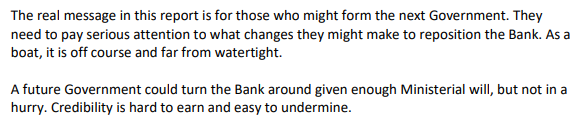
In terms of fixing the institution that seems largely right. It could be fixed, but it will need ministers/governments that care and that are willing to devote sustained attention to using the levers they have to gradually right the ship. As Bryce notes, many of these changes can’t be effected quickly, but mostly because the laws are deliberately (and appropriately) written to make it not easy for new governments of either stripe to make sudden or marked changes. That is helpful when the institution is working well, but quite an obstacle otherwise, and may – if a new government were to care enough – need legislative change.
(I wrote a post here last year with some thoughts on what a new government could and could not do.)
As you watch the interactions between Orr and Nicola Willis at FEC – in which Orr is routinely scornful and dismissive – you wonder how in decency he could possibly continue to serve under a National-led government, But perhaps if he were that sort of person – staying in his lane, acknowledging mistakes, open and engaging etc – the concerns would not exist in the first place. As it is, it would be hard (all but impossible under current law I’d say) to get him out if he wants to stay, and so reform efforts will need to go around him, including progressively replacing the Board with able people and ensuring that the external MPC members are both able and expected to be individually and publicly accountable for their own views and analysis. But do all that and we – and other countries – will still be at risk of really bad macro forecasting errors, and central banks unable to live up to their rhetoric, albeit we might hope for no repeats for another generation or two.