
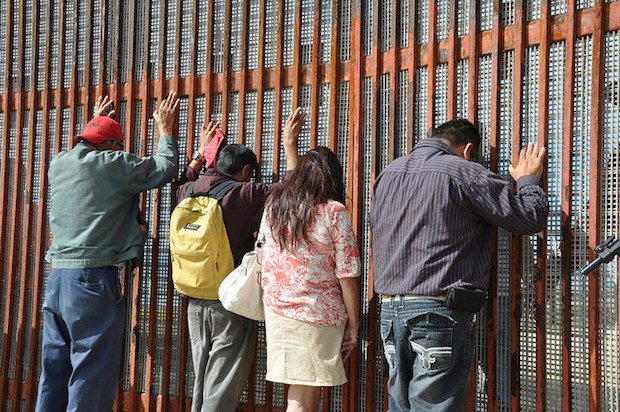
The US-Mexican border region is home to approximately 12 million people, and is the most-crossed international border in the world. Unlike the current physical border, the image people hold of “the border” is not firmly established, and can be modified. One way is via narratives (or stories), which are a powerful tool for gaining support for public policies. Politicians’ narratives about the border have historically been perpetuated by the traditional media, particularly when this allows them to publish sensational and attention grabbing news stories.
However, new social media, including YouTube, provide opportunities for less-mainstream narratives of cooperation. In their Policy & Internet article “Do New Media Support New Policy Narratives? The Social Construction of the U.S.–Mexico Border on YouTube”, Donna L. Lybecker, Mark K. McBeth, Maria A. Husmann, and Nicholas Pelikan find that YouTube videos about the U.S.–Mexico border focus (perhaps unsurprisingly) on mainstream, divisive issues such as security and violence, immigration, and drugs. However, the videos appear to construct more favourable perspectives of the border region than traditional media, with around half constructing a sympathetic view of the border, and the people associated with it.
The common perceptions of the border generally take two distinct forms. One holds the U.S.–Mexico border to be the location of an annual legal flow of economic trade of $300 billion each year, a line which millions of people legally cross annually, the frontier of 100 years of peaceful coexistence between two countries, and the point of integration for the U.S.–Mexico relationship. An alternative perspective (particularly common since 9/11) focuses less on economic trade and legal crossing and more on undocumented immigration, violence and drug wars, and a U.S.-centric view of “us versus them”.
In order to garner public support for their “solutions” to these issues, politicians often define the border using one of these perspectives. Acceptance of the first view might well allow policymakers to find cooperative solutions to joint problems. Acceptance of the second creates a policy problem that is more value-laden than empirically based and that creates distrust and polarization among stakeholders and between the countries. The U.S.–Mexico border is clearly a complex region encompassing both positives and negatives — but understanding these narratives could have a real-world impact on policy along the border; possibly creating the greater cooperation we need to solve many of the urgent problems faced by border communities.
We caught up with the authors to discuss their findings:
Ed.: Who created the videos you studied: were they created by the public, or were they also produced by perhaps more progressive media outlets? i.e. were you able to disentangle the effect of the media in terms of these narratives?
Mark / Donna: For this study, we studied YouTube videos, using the “relevance” filter. Thus, the videos were ordered by most related to our topic and by most frequently viewed. With this selection method we captured videos produced by a variety of sources; some that contained embedded videos from mainstream media, others created by non-profit groups and public television groups, but also videos produced by interested citizens or private groups. The non-profit and media groups more often discuss the beneficial elements of the border (trade, shared environmental protection, etc.), while individual citizens or groups tended to post the more emotional and narrative-driven videos more likely to construct the border residents in a non-deserving sense.
Ed.: How influential do you think these videos are? In a world of extreme media concentration (where even the US President seems to get his news from Fox headlines and the 42 people he follows on Twitter) .. how significant is “home grown” content; which after all may have better, or at least more locally-representative, information than certain parts of the national media?
Mark / Donna: Today’s extreme media world supplies us with constant and fast-moving news. YouTube is part of the media mix, frequently mentioned as the second largest search engine on the web, and as such is influential. Media sources report that a large number of diverse people use YouTube, thus the videos encompass a broad swath of international, domestic and local issues. That said, as with most news sources today, some individuals gravitate to the stories that represent their point of view, and YouTube makes it possible for individuals to do just this. In other words, if a person perceives the US-Mexico border as a horrible place, they can use key words to search YouTube videos that represent that point of view.
However, we believe YouTube to be more influential than some other sources precisely because it encompasses diversity, thus, even when searching using specific terms, there will likely be a few videos included in search results that provide a different point of view. Furthermore, we did find some local, “home grown” content included in search results, again adding to the diversity presented to the individual watching YouTube. Although, we found less homegrown content than initially expected. Overall, there is selectivity bias with YouTube, like any type of media, but YouTube’s greater diversity of postings and viewers and broad distribution may increase both exposure and influence.
Ed.: Your article was published pre-Trump. How do you think things might have changed post-election, particularly given the uncertainty over “the wall“ and NAFTA — and Trump’s rather strident narratives about each? Is it still a case of “negative traditional media; equivocal social media”?
Mark / Donna: Our guess is that anti-border forces are more prominent on YouTube since Trump’s election and inauguration. Unless there is an organized effort to counter discussion of “the wall” and produce positive constructions of the border, we expect that YouTube videos posted over the past few months lean more toward non-deserving constructions.
Ed.: How significant do you think social media is for news and politics generally, i.e. its influence in this information environment — compared with (say) the mainstream press and party-machines? I guess Trump’s disintermediated tweeting might have turned a few assumptions on their heads, in terms of the relation between news, social media and politics? Or is the media always going to be bigger than Trump / the President?
Mark / Donna: Social media, including YouTube and Twitter, is interactive and thus allows anyone to bypass traditional institutions. President Trump can bypass institutions of government, media institutions, even his own political party and staff and communicate directly with people via Twitter. Of course, there are advantages to that, including hearing views that differ from the “official lines,” but there are also pitfalls, such as minimized editing of comments.
We believe people see both the strengths and the weakness with social media, and thus often read news from both traditional media sources and social media. Traditional media is still powerful and connected to traditional institutions, thus, remains a substantial source of information for many people — although social media numbers are climbing, particularly with the President’s use of Twitter. Overall, both types of media influence politics, although we do not expect future presidents will necessarily emulate President Trump’s use of social media.
Ed.: Another thing we hear a lot about now is “filter bubbles” (and whether or not they’re a thing). YouTube filters viewing suggestions according to what you watch, but still presents a vast range of both good and mad content: how significant do you think YouTube (and the explosion of smartphone video) content is in today’s information / media environment? (And are filter bubbles really a thing..?)
Mark / Donna: Yeah, we think that the filter bubbles are real. Again, we think that social media has a lot of potential to provide new information to people (and still does); although currently social media is falling into the same selectivity bias that characterizes the traditional media. We encourage our students to use online technology to seek out diverse sources; sources that both mirror their opinions and that oppose their opinions. People in the US can access diverse sources on a daily basis, but they have to be willing to seek out perspectives that differ from their own view, perspectives other than their favoured news source.
The key is getting individuals to want to challenge themselves and to be open to cognitive dissonance as they read or watch material that differs from their belief systems. Technology is advanced but humans still suffer the cognitive limitations from which they have always suffered. The political system in the US, and likely other places, encourages it. The key is for individuals to be willing to listen to views unlike their own.
Read the full article: Lybecker, D.L., McBeth, M.K., Husmann, M.A, and Pelikan, N. (2015) Do New Media Support New Policy Narratives? The Social Construction of the U.S.–Mexico Border on YouTube. Policy & Internet 7 (4). DOI: 10.1002/poi3.94.
Mark McBeth and Donna Lybecker were talking to blog editor David Sutcliffe.