

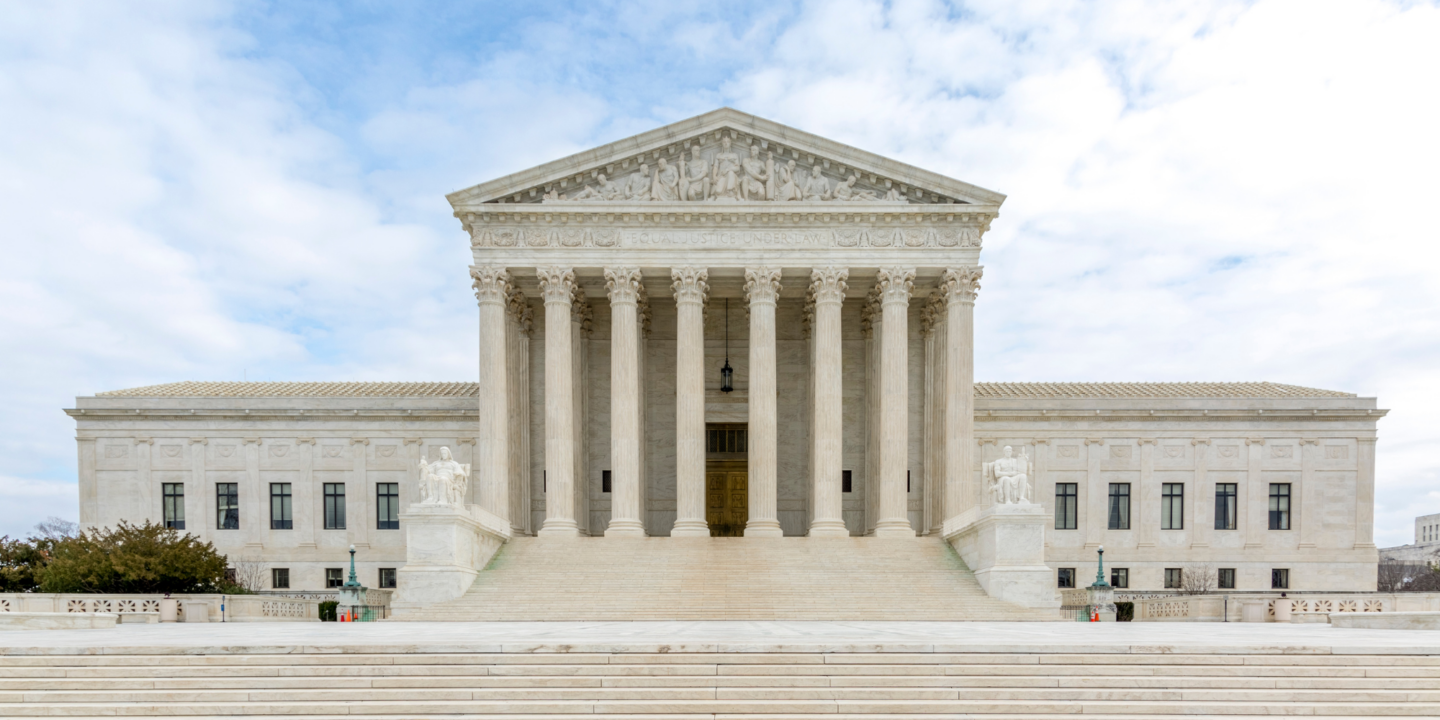
Monday’s oral arguments in NetChoice v. Paxton, and Moody v. NetChoice, the legal battle over Texas and Florida’s controversial social media laws, covered a lot of ground. (You can read our amicus brief for more information.) But while the dialogue was confusing at times, the justices did seem to understand the basic distinction between social media services – where First Amendment concerns are paramount – and other kinds of platforms.
Some of the debate focused on whether either law, especially Florida’s with its broader language, might somehow be salvaged despite severe constitutional concerns. And, they dove into the common law concept of common carriage, which is my Bat Signal.
While most justices seemed convinced that the laws as written can’t stand when applied to core social media sites, Justices Ketanji Brown Jackson and Amy Coney Barrett in particular raised the question of whether these laws could survive if applied to platforms whose core purpose isn’t inherently expressive (think of services like Uber or Amazon). In general, the Court will not strike down a law in its entirety if it could apply in some areas constitutionally. For instance, a law that forbids social media sites from “deplatforming” a user that violates its terms of service is clearly unconstitutional. But a law that prevents Uber from “deplatforming” a driver or rider, or Amazon from deplatforming a seller, is probably fine. Given how quickly these cases made it to the Supreme Court, questions like these were not developed in the lower courts, and the parties each said it’s the other side’s fault that this is the case.
This procedural conundrum isn’t one I have an easy answer for, but I don’t feel bad about this, since neither did the parties, nor the justices, nor the Solicitor General. Whatever the Court does on this point, it must, however, be clear that alleged “nondiscrimination” laws of this kind, when applied to social media, are unconstitutional. Some justices expressed frustration, not that drawing a line between speech regulation and general nondiscrimination or economic regulation is impossible, but that the case is not presented to them in a way that allows them to make those distinctions.
Some supporters of the Texas and Florida laws argue that if they are struck down, all kinds of other regulation of social media services or other platforms, or nondiscrimination laws generally, would be difficult to enforce. They worry, as I do, that a “weaponized” First Amendment will be wielded by corporations to prevent any and all regulation that remotely touches on “speech,” no matter how tenuously. They are right to worry about this in general. But here, the worry is misplaced, and the way to understand this is by understanding what common carriage is, and why it is not what both its supporters and opponents sometimes make it out to be.
Let’s Talk About Common Carriage Again
Opponents of the Texas and Florida laws tend to argue that “common carriage” is an essentially empty concept that simply describes how some kinds of businesses already operate. Supporters, meanwhile, claim slapping the “common carrier” label on anything magically immunizes laws from First Amendment scrutiny. Neither perspective gets it right.
Common carriage is primarily about nondiscrimination – not just about racial, sexual, or other forms of discrimination, but about treating like customers alike, and not refusing customers service for arbitrary reasons.
As I’ve written before, common carriage is a concept with deep historic roots. It arises from the common law “duty of care” applied principally to “bailees”: entities that have been given temporary control of someone else’s messages or goods, and whose job it is to keep them safe or deliver them where the customer specified they should go. Thus, classic common carriers include cargo trains, pipelines, taxi cabs, package delivery companies, postal services, and telephone companies – but also warehouses and inns.
Because common carriage is about nondiscrimination, it can’t be applied to businesses or services that require discrimination in the broad sense named above. Thus, Google Search cannot be a common carrier: The whole purpose of a search engine is to rank and prioritize certain sites above others. This basic function is not compatible with common carriage. This doesn’t mean that the product cannot be regulated in other ways – for example, with rules that prevent search engines from giving priority to their own offerings above those of others. Cable television – not a common carrier – has been regulated in this way for decades. Calling all forms of nondiscrimination laws “common carriage” laws confuses distinct concepts.
Social media, like search, cannot be a common carrier service. Some level of “content moderation” is essential for it to operate – as even Texas and Florida concede in their briefs and before the Court. Without content moderation, social networks would be overrun with spam, scams, abuse, and porn. Some may suggest that social networks only need to take down “unlawful” speech, seemingly unaware that under the First Amendment, very little speech is actually illegal. Most social networks go further than just removing content that violates their policies, of course. The way they choose to organize and present material, algorithmically or otherwise, are all editorial choices that would be illegal under a common carriage regime. These editorial choices are all forms of “discrimination,” of prioritizing some content and users above others. But they are essential to making the services attractive and useful.
Now compare social media to broadband access: We know that “curation” is not necessary for broadband to operate because the best broadband services in the U.S. and the world do no such thing. Not only is it not necessary, but it would also be bad. The fight over net neutrality is about preventing it.
This raises a further question, articulated by Justice Brett Kavanagh when he asked yesterday, “If a company says ‘we’re not a common carrier, we don’t want to be a common carrier’… can the state make them into a common carrier?”
Texas’ response, in essence, was that social media networks are already common carriers under the common law, just by virtue of what they do, and are simply violating their nondiscrimination duties. Because this line of thinking quickly turns into legal metaphysics, a more productive way to ask Justice Kavanaugh’s question is: Can a company be required to operate a common carriage service that operates under nondiscrimination principles, consistently with the First Amendment? I think the answer is “yes.”
Common carriage is a non-expressive activity, even when it involves transmitting others’ expression. As the D.C. Circuit Court of Appeals found, common carriers “have long been subject to nondiscrimination and equal access obligations… without raising any First Amendment question. Those obligations affect a common carrier’s neutral transmission of others’ speech, not a carrier’s communication of its own message.”
Thus, telling a business that properly can be a common carrier, like a broadband provider, that it must operate as one, does not violate the First Amendment. It is not a form of “forced speech” because this form of transmission is not speech at all.
Broadband companies also argue that they might want to curate the internet. But even assuming there are legitimate expressive (as opposed to business) reasons for this, nothing about common carriage prevents a broadband provider from communicating its own message in other ways.
By contrast, social media is inherently expressive. The dissemination of social media posts is not “transmission,” but publication. Ordering a social media site to operate as a common carrier is unconstitutional for the same reason that ordering a newspaper to print all letters to the editor would be.
Be Careful What You Wish For
But even if a law got past the constitutional hurdles, the prize would be a social media service that is bad, and that few people want to use, either for connecting with friends or for advertising. Alternative social networks that have sprung up with a “free speech” policy tend to quickly adopt content moderation rules or die out.
At least Texas seemed to concede that its law would make social networks much uglier places at oral argument: The state’s Solicitor General, Aaron Nielson, agreed that under Texas’ law, a site that removed pro-terrorist content (which, as Justice Kavanagh pointed out, is constitutionally protected) would have to remove anti-terrorist content, as well. He commented on this point (edited from the transcript for clarity):
“All you have left are voluntary people wanting to talk to each other. And, I mean, people say horrible things on the telephone… I don’t think we’ve ever thought, well, you know what… we’re going to turn that off. Because we don’t want the telephone providers to be able to say — have that sort of right to — to censor.”
I agree with Solicitor General Nielson and the state of Texas that we don’t want common carriers like the telephone or broadband company to interfere with what people say. But social media services are different. They publicly disseminate information. It is not at all reasonable to tell a social media service that it must treat pro-terrorism, pro-suicide, or pro-bulimia content the same as advocacy against those things, on pains of violating a nondiscrimination or “viewpoint neutrality” requirement. If the legal doctrine articulated above is not enough to make the case that social media is not like the telephone, then maybe the practical results conceded by Texas will be enough.