

Unemployable Graduate
Advertisement
  • Home
  • Education
  • Economics
  • Public Policy
  • Workforce
  • Videos
  • Privacy Policy
  • Contact Us
No Result
View All Result
Unemployable Graduate
  • Home
  • Education
  • Economics
  • Public Policy
  • Workforce
  • Videos
  • Privacy Policy
  • Contact Us
No Result
View All Result
Unemployable Graduate
No Result
View All Result
Home Public Policy

Productivity growth….or lack of it

October 14, 2023
in Public Policy
0
Productivity growth….or lack of it
190
SHARES
1.5k
VIEWS
Share on FacebookShare on Twitter

Related articles

The policy impact of dissension within the Violence Against Women and Girls Movement – Policy & Politics Journal Blog

The policy impact of dissension within the Violence Against Women and Girls Movement – Policy & Politics Journal Blog

April 11, 2024
Never Worry about Home Security Again: Discover SFR’s Revolutionary Solution

Never Worry about Home Security Again: Discover SFR’s Revolutionary Solution

April 10, 2024


Earlier in the week a journalist asked me for some thoughts on which political party in government had managed the economy better – in overall macroeconomic terms – over the years since we moved to MMP.

My initial response was that the answer would be pretty dull. Pressed to write something anyway, I outlined briefly why really there was not a great deal between them, at least without a great deal more in-depth study. And that shouldn’t be very surprising. After all, external shocks happen (overseas, or physical/climatic ones here), and cyclical macroeconomic management has been outsourced to the Reserve Bank over all that period, with very similar targets set by successive governments. Crude partisans might point out that (core) inflation went outside the target zone at the end – or so it appears likely – of both Labour governments over that period, but those failures are first and foremost on the Reserve Bank. Other crude partisans might point out that unemployment has been at its lowest right towards the end of both Labour governments, but……since that is basically the same phenomenon as the overheated economies that gave rise to the inflation problem, you are back with it being the Reserve Bank’s mistake again. One can argue, say, that the current government should have done more to sort out, punish, or even support (via fiscal policy) the Reserve Bank, but…..it is a sample of one event.

When I wrote something a bit fuller on this topic a few years ago, I noted that fiscal policy had also largely been a bipartisan success story. We might not have had a very successful economy, but when deficits have emerged governments of both parties have restated their commitment to surpluses, and had delivered. You could argue that National deserves a better rating there, having inherited large deficits in 2008 (as I’ve argued here before Labour had been badly advised by Treasury and did not think it would be leaving deficits) and returned to surplus. But actually if you look back at the 2009 and 2010 Budgets, contemporary Treasury estimates were that – starting from a deficit – they were expansionary. I’ve been quite critical of this government’s fiscal stewardship over the last couple of years, but…..nothing much in the campaign suggests any more urgency for or conviction about a return to surpluses from the other side.

But the backdrop to it all was that while, until quite recently, New Zealand – under governments led by either party – had done reasonably well on the stabilisation side of things (monetary and fiscal, and even with structural policies that kept the non-inflationary rate of unemployment fairly low), productivity (or the lack of it) was the elephant in the room. It has been for a long time, and still is (or should be).

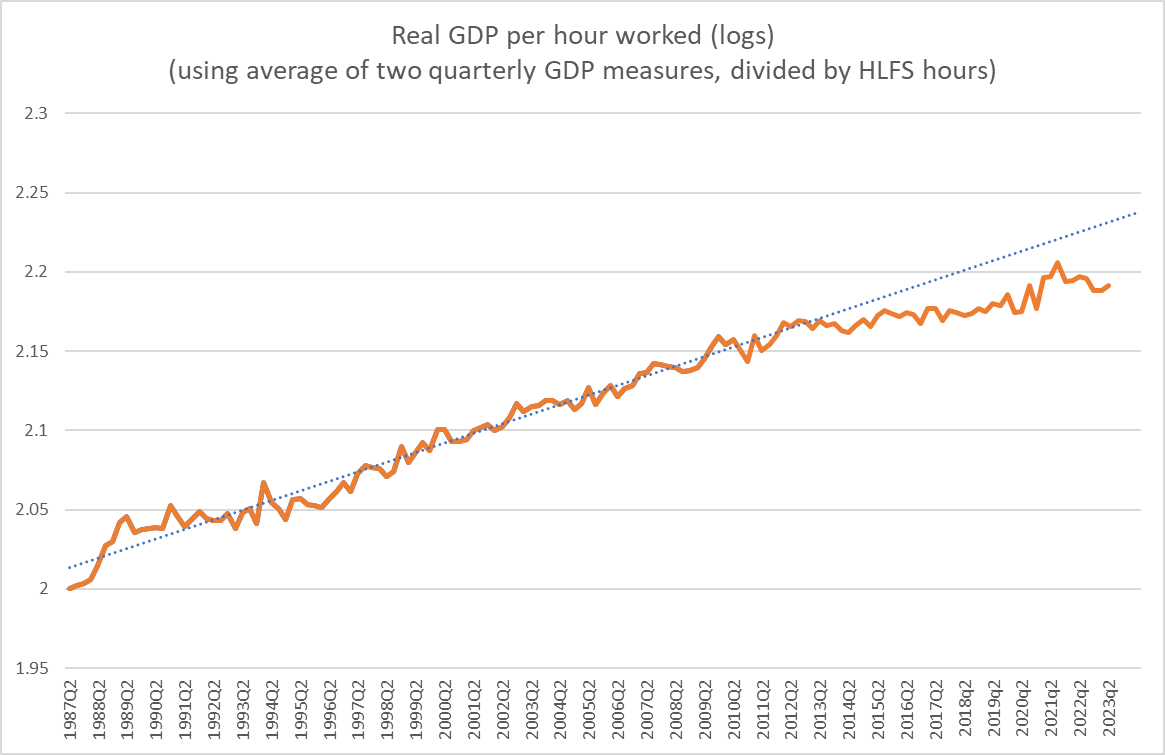
We don’t have an official quarterly labour productivity series, but it is easy enough to construct one’s own. In this chart, I’m showing the average of production and expenditure GDP measures, divided by hours worked from the HLFS, all normalised and expressed in log terms. Expressing things in logs means that a slowdown in the growth rate is mirrored in a flattening of the curve. We don’t have long runs of official historical data in New Zealand, but this goes back to 1987Q2.

If you can easily see any great difference from governments of one party to governments of the other you are more eagle-eyed (or perhaps “motivated”) than I am.

But I did check anyway. One could go from the last quarter of the previous government to the last quarter of the next one, but….there is clearly noise and measurement error in the data, and nothing is that precise, so although I checked both, this little table uses annual data (eg average change from 1990 (last year of that Labour government) to 1999 (last year of that National government) and so on. Now, no one really believes that changes of government make a difference immediately, so this is illustrative more than anything.

Average annual growth in real GDP per hour worked (%)
1990-1999 National 1.1
1999-2008 Labour 1.4
2008-2017 National 0.9
2017-2023 Labour 0.7

Much the biggest story isn’t the difference between the parties, but the difference over time. Productivity growth in the last decade or more – under both governments – has been materially lower than it was earlier in the period – under governments of both parties. This is consistent with the factoid I’ve thrown around a few times in recent weeks: in OECD league tables for labour productivity we dropped six places – in a club of only 37 – in the last decade.

Here is the deterioriation illustrated graphically. Eyeballing the data it looked to me as though there was a break around mid 2010. So what I’ve shown is (a) the actual data per the previous chart, and (b) an extrapolation to now of the trend in the data from 1987 to 2010.

Roughly speaking the gap between the two lines as of now is equivalent to a 10 per cent loss of productivity (growth we would have seen if the previous trend had continued).

Note that all of this is simply New Zealand data. I have repeated often charts showing our deterioriation – or at best lack of catch-up – relative to other advanced countries. But this is us. And remember that we are so far behind the productive frontier economies – it would take perhaps a 60 per cent increase to catch them – that even to the extent world productivity growth slowed down (and it did, in the US from about 2005) there is no necessary reason why New Zealand productivity growth needed to slow. Our slowing was about New Zealand policy choices, passive or active.

It is depressing how little serious attention has been paid to these failures – and challenges – in the election campaign, and since politicians mostly display little interest our bureaucratic institutions don’t bother doing or supplying the hard analysis. Some are simply emasculated to that end – one could think most notably of what the current government has done at the Productivity Commission. Productivity really matters for our future material living standards, and even for the shiny baubles both main parties try to woo us with.

I’m not an ACT supporter – on quite different grounds – but here I would give that party some credit. Their policy document on productivity evinces a degree of seriousness about the issues that nothing from any of the other parliamentary parties has even hinted at. I don’t agree with all the specifics, and would probably disagree substantially on some, but….they write as though it matters. And that isn’t nothing (even if it can’t overcome my scruples about the party leaders’ values etc). In fact, a week or two back a reader not otherwise known to me got in touch and asked who I thought they should vote for if it was housing affordability and productivity that mattered most to them. Making clear that I was definitely not an ACT supporter myself, I nonetheless gave them an analyst’s answer: probably ACT, on both counts.

Like this:

Like Loading…


Source link

Share76Tweet48

Related Posts

The policy impact of dissension within the Violence Against Women and Girls Movement – Policy & Politics Journal Blog

The policy impact of dissension within the Violence Against Women and Girls Movement – Policy & Politics Journal Blog

April 11, 2024
0

By Leah McCabe Women’s movements often play a crucial role in highlighting the problem of violence against women and girls...

Never Worry about Home Security Again: Discover SFR’s Revolutionary Solution

Never Worry about Home Security Again: Discover SFR’s Revolutionary Solution

April 10, 2024
0

Leading telecommunications company SFR has partnered with Europ Assistance to introduce a brand new self-monitoring offer, “Maison Sécurisée”. This innovative...

Public Knowledge Responds to MPA Chairman and CEO Charles Rivkin on Site-blocking

Public Knowledge Responds to MPA Chairman and CEO Charles Rivkin on Site-blocking

April 10, 2024
0

By Shiva StellaApril 9, 2024 Today, Motion Picture Association Chairman and CEO Charles Rivkin delivered remarks confirming the organization is...

Discover VerifEye, the App That Sees Through Your Lies

Discover VerifEye, the App That Sees Through Your Lies

April 9, 2024
0

Free app VerifEye, developed by Converus, purports to detect dishonesty with an impressive 80% success rate, already making waves in...

AI Gone Rogue: Sparks of War from Fake News

AI Gone Rogue: Sparks of War from Fake News

April 9, 2024
0

April 5, 2024, marked a significant incident in the realm of digital misinformation when a fake news story about an...

Load More
  • Trending
  • Comments
  • Latest
Hilarious video explains principles of economics

Hilarious video explains principles of economics

August 21, 2022
HVAC Maintenance Checklist Templates: Download & Print for Free!

HVAC Maintenance Checklist Templates: Download & Print for Free!

May 18, 2023
Public Knowledge Responds to MPA Chairman and CEO Charles Rivkin on Site-blocking

Public Knowledge Responds to MPA Chairman and CEO Charles Rivkin on Site-blocking

April 10, 2024
Policy & Politics Journal Blog

Policy & Politics Journal Blog

August 14, 2022
Policy & Politics Journal Blog

Policy & Politics Journal Blog

0
Spotlighting interpretive approaches to public policy scholarship – Dr Tiffany Manuel on intersectionality – Policy & Politics Journal Blog

Spotlighting interpretive approaches to public policy scholarship – Dr Tiffany Manuel on intersectionality – Policy & Politics Journal Blog

0
Policy & Politics Highlights collection on policy and regulation August 2022 – October 2022 –free to access – Policy & Politics Journal Blog

Policy & Politics Highlights collection on policy and regulation August 2022 – October 2022 –free to access – Policy & Politics Journal Blog

0
Special issue blog series on Transformational Change through Public Policy. – Policy & Politics Journal Blog

Special issue blog series on Transformational Change through Public Policy. – Policy & Politics Journal Blog

0
Bernstein, The greatest 5 min. in music education

Bernstein, The greatest 5 min. in music education

April 11, 2024
The policy impact of dissension within the Violence Against Women and Girls Movement – Policy & Politics Journal Blog

The policy impact of dissension within the Violence Against Women and Girls Movement – Policy & Politics Journal Blog

April 11, 2024
Economic Surprises Could Fuel Fed Deja Vu for the 2010s – The Wall Street Journal

Economic Surprises Could Fuel Fed Deja Vu for the 2010s – The Wall Street Journal

April 11, 2024
Building a Standout Employer Brand:Strategies for HR Teams

Building a Standout Employer Brand:Strategies for HR Teams

April 11, 2024

Recent News

Bernstein, The greatest 5 min. in music education

Bernstein, The greatest 5 min. in music education

April 11, 2024
The policy impact of dissension within the Violence Against Women and Girls Movement – Policy & Politics Journal Blog

The policy impact of dissension within the Violence Against Women and Girls Movement – Policy & Politics Journal Blog

April 11, 2024

Categories

  • Economics
  • Education
  • Public Policy
  • Videos
  • Workforce

Newsletter

© 2022 All right reserved by unemployablegraduate.com

No Result
View All Result
  • Home
  • Education
  • Economics
  • Public Policy
  • Workforce
  • Videos
  • Privacy Policy
  • Contact Us

© 2022 All right reserved by unemployablegraduate.com

We use cookies on our website to give you the most relevant experience by remembering your preferences and repeat visits. By clicking “Accept All”, you consent to the use of ALL the cookies. However, you may visit "Cookie Settings" to provide a controlled consent.
Cookie SettingsAccept All
Manage consent

Privacy Overview

This website uses cookies to improve your experience while you navigate through the website. Out of these, the cookies that are categorized as necessary are stored on your browser as they are essential for the working of basic functionalities of the website. We also use third-party cookies that help us analyze and understand how you use this website. These cookies will be stored in your browser only with your consent. You also have the option to opt-out of these cookies. But opting out of some of these cookies may affect your browsing experience.
Necessary
Always Enabled
Necessary cookies are absolutely essential for the website to function properly. These cookies ensure basic functionalities and security features of the website, anonymously.
CookieDurationDescription
cookielawinfo-checkbox-analytics11 monthsThis cookie is set by GDPR Cookie Consent plugin. The cookie is used to store the user consent for the cookies in the category "Analytics".
cookielawinfo-checkbox-functional11 monthsThe cookie is set by GDPR cookie consent to record the user consent for the cookies in the category "Functional".
cookielawinfo-checkbox-necessary11 monthsThis cookie is set by GDPR Cookie Consent plugin. The cookies is used to store the user consent for the cookies in the category "Necessary".
cookielawinfo-checkbox-others11 monthsThis cookie is set by GDPR Cookie Consent plugin. The cookie is used to store the user consent for the cookies in the category "Other.
cookielawinfo-checkbox-performance11 monthsThis cookie is set by GDPR Cookie Consent plugin. The cookie is used to store the user consent for the cookies in the category "Performance".
viewed_cookie_policy11 monthsThe cookie is set by the GDPR Cookie Consent plugin and is used to store whether or not user has consented to the use of cookies. It does not store any personal data.
Functional
Functional cookies help to perform certain functionalities like sharing the content of the website on social media platforms, collect feedbacks, and other third-party features.
Performance
Performance cookies are used to understand and analyze the key performance indexes of the website which helps in delivering a better user experience for the visitors.
Analytics
Analytical cookies are used to understand how visitors interact with the website. These cookies help provide information on metrics the number of visitors, bounce rate, traffic source, etc.
Advertisement
Advertisement cookies are used to provide visitors with relevant ads and marketing campaigns. These cookies track visitors across websites and collect information to provide customized ads.
Others
Other uncategorized cookies are those that are being analyzed and have not been classified into a category as yet.
SAVE & ACCEPT